Guides · Scoring guide
Birdie, bogey and the rest.
Every name for a score against par, from condor to triple bogey, plus even, plus and minus, gross and net, and where the words came from.
November 1, 2026
Golfers name their good scores after birds and their bad ones after a goblin. The first birds are American, hatched at Atlantic City Country Club around 1900. The goblin is British, from the 1890s, and when it first turned up on a golf course it meant what par means today.
The short answer
Each term measures one hole against its par. A birdie is one under par, an eagle two under, an albatross (a double eagle in the US) three under, and a condor four under. A bogey is one over par, a double bogey two over, a triple bogey three over. A hole-in-one, or ace, is a 1 on any hole.
For a round, golfers count against par: even, or E, means level with par; +4 is four over; −2 is two under.
The whole ladder
| Term | Against par | Par 3 | Par 4 | Par 5 |
|---|---|---|---|---|
| Condor | 4 under | – | – | 1 |
| Albatross (double eagle) | 3 under | – | 1 | 2 |
| Eagle | 2 under | 1 | 2 | 3 |
| Birdie | 1 under | 2 | 3 | 4 |
| Par | Level | 3 | 4 | 5 |
| Bogey | 1 over | 4 | 5 | 6 |
| Double bogey | 2 over | 5 | 6 | 7 |
| Triple bogey | 3 over | 6 | 7 | 8 |
Read the 1s. A hole-in-one has a second name on every hole, because it’s also a score against par: an eagle on a par 3, an albatross on a par 4, a condor on a par 5.
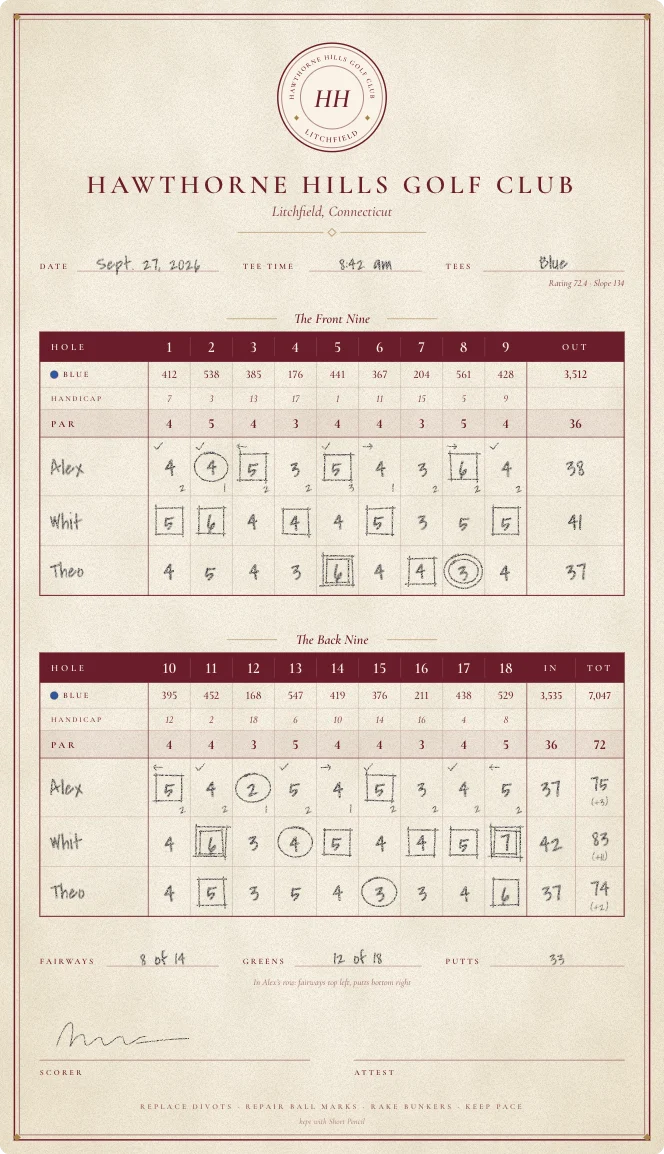
On a card, the names turn into marks: circles under par, boxes over it, which our guide to scorecard symbols covers.
Par
Par is the score a scratch golfer is expected to make on a hole, allowing two putts. Our guide to scorecard terms covers how a club decides whether a hole is a 4 or a 5. The word is older than the row on the card.
It came from the stock market by way of a journalist. Before the 1870 Open at Prestwick, the golf writer A.H. Doleman asked two professionals, David Strath and James Anderson, what perfect play would score over the twelve-hole course. They said 49, and Doleman borrowed the market’s word for a normal value and called it par. Young Tom Morris won that Open with 149 over three rounds, two over par.
The USGA made par official in 1911, defining it as perfect play without flukes, in ordinary weather, with two putts on every green. The R&A followed in 1925.
Birdie and eagle
A birdie is one under par: a 3 on a par 4. The USGA’s history of golf in New Jersey, drawing on H.B. Martin’s 1936 book Fifty Years of American Golf, places its birth in an 1899 foursomes match at Atlantic City Country Club. Ab Smith hit his ball to within six inches of the hole, called it “a bird of a shot”, and proposed that anyone who played a hole in one under par should be paid double. In 19th-century slang, “bird” meant anything excellent, and a one-under hole became a birdie.
The details wobble. The club’s own plaque dates the round to 1903, and a USGA article from January 2026 tells it that way: on the 2nd hole, with Smith’s brother William and George Crump, who went on to build Pine Valley, in the group. Both versions put Ab Smith at Atlantic City; the year depends on which USGA page you read.
The eagle, two under, arrived soon after on the same logic. If a bird was good, the bird on America’s national emblem had to be better.
Albatross or double eagle?
Three under par is a 2 on a par 5, or an ace on a par 4. Smith’s group called it a double eagle, and Americans still do. The rest of the golfing world mostly says albatross, a word the USGA says became the preferred choice in the 1920s, though nobody wrote down how it got the job.
We say albatross, on purpose. An eagle is two under, so a “double eagle” ought to be four, and the arithmetic has never worked. The albatross also keeps the ladder in one family of birds. Short Pencil’s keypad says albatross on the key that would make one.
The most famous one in golf is still known as a double eagle. At the 1935 Masters, Gene Sarazen holed a 4-wood from 235 yards on the par-5 15th for a 2, caught Craig Wood in the final round and won the 36-hole playoff the next day. Louis Oosthuizen’s 4-iron from 253 yards on the par-5 2nd in 2012 was only the fourth in the tournament’s history.
Condor and ace
A condor is four under par, which in practice means a hole-in-one on a par 5. Scottish Golf History counted six recorded condors in 2023. The first credited is Larry Bruce’s in 1962, on the 480-yard par-5 5th at Hope Country Club in Arkansas, where he cut the corner of the dogleg. The longest recorded is Mike Crean’s 2002 ace on the 517-yard 9th at Green Valley Ranch in Denver.
The odd one out came on December 10, 2020, when Kevin Pon made a 2 on the 649-yard par-6 18th at Lake Chabot in Oakland, California: a drive and a 110-yard pitching wedge. It’s the only condor on the list that isn’t an ace. Ace and hole-in-one mean the same thing, a 1 on any hole.
Bogey and beyond
A bogey is one over par: a 5 on a par 4, though it started out meaning something else. In 1890, Hugh Rotherham, secretary of Coventry Golf Club, proposed a standard number of strokes a good golfer should take at each hole, which he called the ground score. Dr Thomas Browne took the idea up for matches at Great Yarmouth, where golfers likened that elusive score to the Bogey Man of a popular music-hall song, and the ground score became the bogey score. At the United Services Club in Gosport, whose members held military rank, members gave the imaginary opponent an honorary rank of his own, and Colonel Bogey was born. By January 2, 1892, The Field was reporting a bogey tournament.
In Britain, bogey was the target, doing the job par does now. In the US, where par had national distance standards from 1911, golfers began using bogey for one over par instead, and by the middle of the 20th century that meaning had stuck.
Past bogey, the names run out. Two over is a double bogey, three over a triple, and after that most golfers say the number; an 8 is sometimes called a snowman, for its shape. Short Pencil’s keypad names every score from albatross to double and leaves the rest as plain numbers, the same way the card stops at two boxes.
Even, plus and minus: scoring a round
Total up a round and golfers describe it against par rather than in strokes. Level with par is even, written E on a leaderboard and called level par in Britain. Over par takes a plus sign: a 79 on a par 72 is +7, “seven over”. Under par takes a minus: a 70 is −2, “two under”. Mid-round you’ll also hear thru, the number of holes played, as in “one over thru six”.
Short Pencil keeps score that way too. The scoring screen shows where each player stands, +1 thru 6, and the finished card shows the score against par in brackets after the total: 75 (+3), or (E) on a level day.
Two more words matter once handicaps come in. Your gross score is the strokes you took. Your net score is gross minus your handicap strokes, which is where net pars and net birdies come from: a 5 on a par 4 where you receive a stroke is a net par. And net double bogey is the most any hole can count for when you post a score: par, plus two, plus any strokes you get there. The arithmetic is in our guide to handicap strokes.
Up and down, and the rest
A handful of other terms describe how a score was made rather than what it was:
- Up and down: holing out in two strokes from off the green, one to get on and one putt. From a bunker it’s a sand save, which the PGA Tour keeps as a stat of its own.
- Three-putt: taking three putts on a green, one of the quickest ways a par turns into a bogey. Our guide to tracking stats on your scorecard covers counting putts.
- Gimme: a short putt your opponent concedes. Concessions belong to match play; in stroke play every putt is holed. More in our guide to match play.
- Blow-up hole: the one where the number got away from you. In Stableford it costs you only that hole’s points; see Stableford scoring.
Golfers stopped naming bad scores at triple bogey, so treat an 8 as a number: write it down, walk to the next tee, and know that a birdie there gets one of those strokes back.
Questions
What is a birdie in golf?
One stroke under par on a hole: a 2 on a par 3, a 3 on a par 4 or a 4 on a par 5. The term is usually traced to Atlantic City Country Club around 1900, from the slang “bird” for anything excellent.
What is the difference between an eagle and an albatross?
An eagle is two under par on a hole, such as a 3 on a par 5. An albatross is three under, such as a 2 on a par 5 or a hole-in-one on a par 4. In the US an albatross is often called a double eagle.
What is a condor in golf?
Four under par on a single hole: a hole-in-one on a par 5, or a 2 on a par 6. Only a handful are on record, the first credited to Larry Bruce at Hope Country Club in Arkansas in 1962.
What is a bogey in golf?
One stroke over par on a hole, such as a 5 on a par 4. Two over is a double bogey and three over a triple bogey. In Britain, bogey originally meant the target score for a hole.
What does even mean in golf?
Level with par for the holes played, written E on a leaderboard. A golfer who is even through nine on a par-36 front nine has taken 36 strokes.
Is a hole-in-one an eagle?
On a par 3, yes: a 1 on a par 3 is two under par. A hole-in-one on a par 4 is an albatross, and on a par 5 it’s a condor.
What does up and down mean in golf?
Getting the ball in the hole in two strokes from off the green, one to get it onto the green and one putt. From a bunker, it’s called a sand save.