Guides · Scorecard guide
Golf scorecard symbols.
Why golfers circle birdies and box bogeys, what the doubles mean, and the small marks for putts and fairways.
October 20, 2026
Nobody wrote the circle into the Rules of Golf. It’s there because a scorecard gets read at a glance, and a ring around a 3 on a par 4 says something a column of numbers can’t: that was the good hole. The box does the opposite job, and between them they turn eighteen numbers into the story of a round.
The short answer
A circle means a birdie, one under par. Two circles mean an eagle, two under. A square means a bogey, one over. Two squares mean a double bogey or worse. A par gets no mark at all.
| Mark | Name | Against par |
|---|---|---|
| Two circles | Eagle (or better) | 2 or more under |
| One circle | Birdie | 1 under |
| No mark | Par | Level |
| One square | Bogey | 1 over |
| Two squares | Double bogey (or worse) | 2 or more over |
None of this is official; the Rules of Golf only care about the number in each box. It’s a convention, the same one the PGA Tour uses on its own online scorecards, and it’s close enough to universal that a playing partner will read your card without asking.
Why circles and squares work
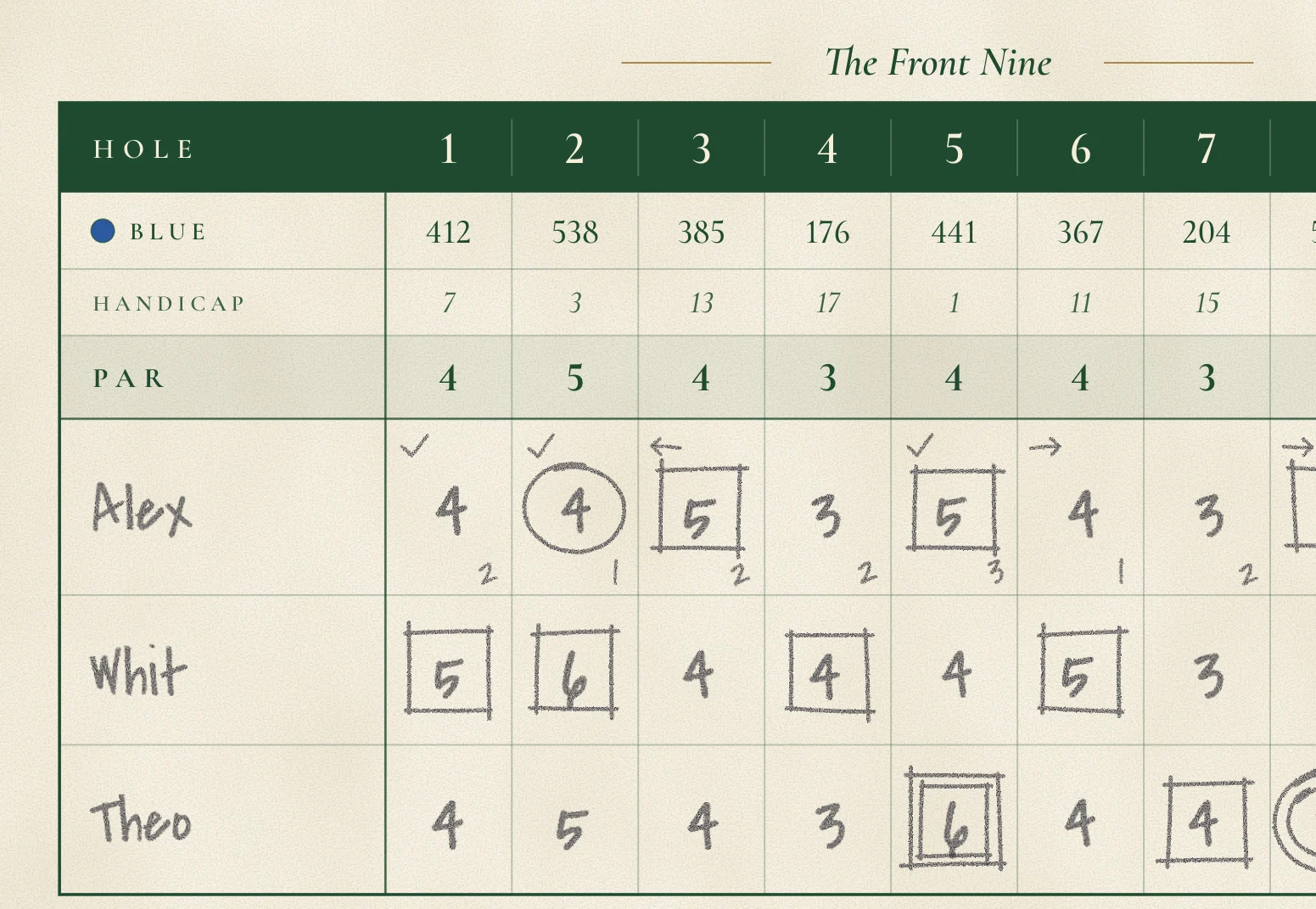
Look at the card above for two seconds and you know how each round went before you’ve added anything up. Whit’s row is a fence of boxes with gaps for pars. Theo was cruising until the 5th. Alex made the one circle.
That’s the whole point. Totals tell you what you shot; the marks tell you where. A cluster of squares on the same three holes, round after round, is worth more to your game than any average. It usually points at one shot: the long par 3 you always come up short on, the dogleg you keep running through.
Shapes also beat color. Broadcasters each pick their own colors for scores, and when The Open changed its scheme at Royal Troon in 2024, turning pars blue and bogeys black, viewers complained loudly. Nobody has ever been confused by a circle. It survives pencil, rain and a cart’s cupholder, and it’s still a circle on a smudged card in a glovebox three seasons later.
Doubles, triples and everything past them
Two circles for an eagle and two squares for a double bogey are as standard as the singles. Past that, there’s no agreement. Some golfers draw a third ring for an albatross, and some apps fill the shape in instead of doubling it.
We stop at two, on purpose, and so does the PGA Tour’s scorecard: its legend reads two circles for “Eagle –” and two squares for “D Bogey+”. Short Pencil circles twice for an eagle or anything better and boxes twice for a double bogey or anything worse. A card is for reading, and a triple box on a triple bogey adds insult without adding information: the number inside already tells you how bad it was. If you’ve made an albatross, believe us, you’ll remember it without the extra ring.
Gross or net: what do you circle?
Mark the gross score, the strokes you actually took, against the hole’s par. A 4 on a par 5 gets its circle whatever your handicap. That’s the common practice, and it keeps the marks honest: the circle means you beat the hole, not the arithmetic.
Handicap strokes get their own, smaller mark. Many golfers put a dot in the corner of each box where they receive a stroke (playing partners call them “dots” or “pops”), so a 5 with a dot on a par 4 reads as a net par at a glance. In a match, those dots matter more than any circle.
The small marks: putts, fairways and penalties
Golfers who keep stats tuck them into the corners of each box, small enough not to fight the score. There’s no standard here either, but this layout is common, and it’s the one Short Pencil pencils in when you track your stats:
| Where | Mark | Means |
|---|---|---|
| Top left | A tick | The tee shot found the fairway |
| Top left | An arrow, ← or → | The tee shot missed left or right |
| Top right | P, or P2 | One penalty stroke, or two |
| Bottom right | A small number | Putts on the hole |
Fairways only count on par 4s and 5s, so a par 3 never gets a tick. Greens in regulation don’t need a mark of their own: if the score minus the putts leaves two strokes or fewer on a par 4, you were on in regulation. Short Pencil works that out for you and totals all four on the line under your row before you sign.
Marking your own card
Write the number first and draw the shape around it, so the number stays legible. On a busy card, keep circles and squares inside the box rather than across the lines into the next hole.
And remember what counts. In a competition the only thing that matters is the number in each box, certified by your marker and by you under Rule 3.3b. The circles and squares are for you. Nobody is ever penalized for a missing ring, but a wrong number can cost you the round, so check the numbers before you admire the shapes.
If you’d rather not do any of it, Short Pencil draws every circle and square in pencil as you go, from the scores you tap in and the par of each hole, and the finished card is waiting when you walk off the 18th.
Questions
What does a circle mean on a golf scorecard?
A circle around a score means a birdie: one stroke under par for that hole. Two circles mean an eagle, two under.
What does a square mean on a golf scorecard?
A square or box around a score means a bogey: one stroke over par. Two squares mean a double bogey, and many golfers use them for anything worse too.
What does a triangle mean on a golf scorecard?
There’s no standard meaning. The common marks are circles for scores under par and squares for scores over it; a triangle means whatever the person who marked the card meant by it.
Do you circle birdies on your gross score or your net score?
Usually the gross score: the strokes you actually took, against par. Handicap strokes are shown separately, often as a small dot in the corner of the box.
What do dots on a golf scorecard mean?
Dots usually mark the holes where a player receives a handicap stroke, so their net score on that hole is one less than the number written.
Are scorecard symbols part of the Rules of Golf?
No. The Rules care only about the gross score for each hole, certified by the marker and the player. Circles and squares are an informal convention.