Guides · Scoring guide
How to keep score in match play.
Holes won, lost and halved, marking the card, what dormie and 3 and 2 mean, handicap strokes, and conceded putts.
October 24, 2026
On the card below, Theo shoots 74 and Alex shoots 75. Played as a match, Alex wins, 2 up. Nothing went wrong with the arithmetic. In match play you win and lose holes one at a time, and the total at the bottom of the card decides nothing.
The short answer
Play each hole against your opponent. Fewer strokes wins the hole; the same number ties it, or “halves” it. You count the match in holes: “2 up”, “1 down”, “all square”. It ends when one player is ahead by more holes than are left, written like 3 and 2: three up with two to play.
On the card, write both players’ scores, mark each hole + (won), − (lost) or 0 (halved) from your side, and keep the running status beside it.
Holes, not strokes
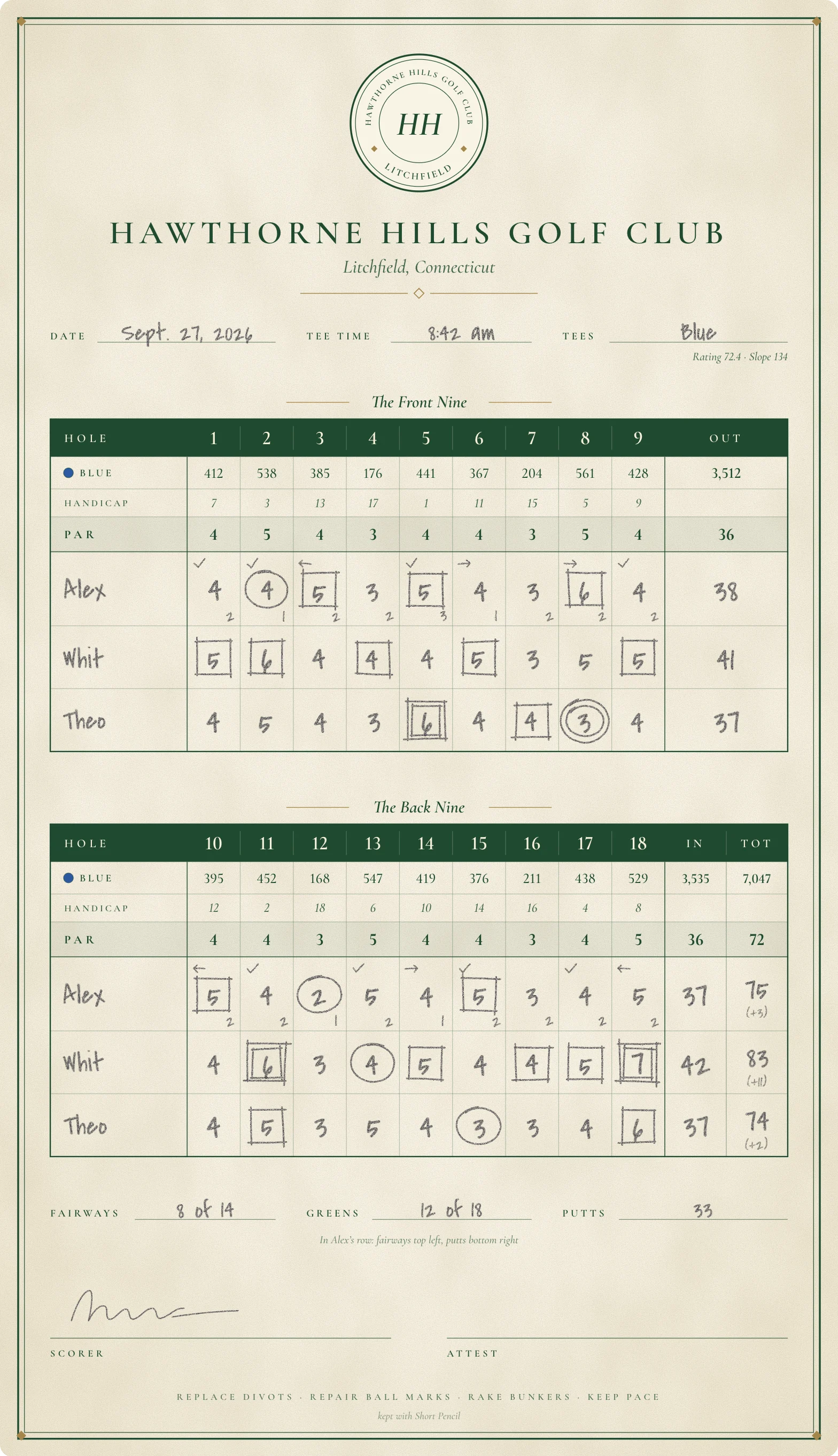
Rule 3.2a is short. You win a hole by completing it in fewer strokes than your opponent, penalty strokes included, or when your opponent concedes it or takes a loss-of-hole penalty. Take the same number of strokes and the hole is “tied (also known as ‘halved’)”, in the Rules’ own words.
Look at the 8th on the card. Theo makes an eagle 3 on the par 5; Alex makes a 6. In stroke play that’s a three-shot swing. In match play it’s one hole, worth as much as Alex’s par beating Theo’s bogey on the 7th. Over 18 holes Alex wins six, Theo wins four, and eight are halved. Six minus four: Alex wins 2 up, and Theo’s better total doesn’t come into it.
That changes how you play. A lost hole costs you that one hole and nothing more, so the next tee is a fresh start, and a scrappy 5 that halves a hole counts for as much as a perfect one.
Marking a match on the card
There’s no official notation. Two are common: +, − and 0 for won, lost and halved, or W, L and H. Mark the result from your own side of the match, and keep a running status in the column beside it. Alex’s back nine against Theo, marked from Alex’s side, starting the 10th 1 up:
| Hole | Par | Alex | Theo | Mark | Match |
|---|---|---|---|---|---|
| 10 | 4 | 5 | 4 | − | All square |
| 11 | 4 | 4 | 5 | + | 1 up |
| 12 | 3 | 2 | 3 | + | 2 up |
| 13 | 5 | 5 | 5 | 0 | 2 up |
| 14 | 4 | 4 | 4 | 0 | 2 up |
| 15 | 4 | 5 | 3 | − | 1 up |
| 16 | 3 | 3 | 3 | 0 | 1 up |
| 17 | 4 | 4 | 4 | 0 | 1 up (dormie) |
| 18 | 5 | 5 | 6 | + | Won 2 up |
Write the strokes beside the marks. If anyone questions a hole, the two scores settle it, and they’re what you’ll need if you post the round for your handicap.
And say the status out loud on each tee. Rule 3.2d(3) expects both players to know the match score. If you both agree on a wrong one and nobody corrects it before the next hole starts, the wrong score becomes the real one.
Up, down, all square and dormie
| You’ll hear | It means |
|---|---|
| 2 up / 2 down | Ahead or behind by two holes. |
| All square | Level. The Rules use the phrase themselves, in Rule 3.2d(3). |
| Dormie | Ahead by exactly as many holes as are left. The leader can no longer lose in regulation, only be caught. |
| 3 and 2 | Won three up with two holes to play, so the match is over early. |
| 1 up, 2 up (as a result) | The match went the full 18 and was won by that margin. |
| Won at the 19th | Tied after 18, won on the first extra hole. |
“Dormie” is golfers’ slang, and you won’t find it in the Rules. On the card above, Alex is dormie after halving the 17th: 1 up with one to play. Theo has to win the 18th to force extra holes, and loses it instead.
How a match ends
Under Rule 3.2a(3), a match is over when one player leads by more holes than remain, when the opponent concedes the match, or when the opponent is disqualified. You write the margin as holes up and holes left. The biggest possible win over 18 holes is 10 and 8: you can’t lead by more holes than remain until at least ten have been played.
The Ryder Cup record for an 18-hole match is 9 and 7, set on September 30, 2023, at Marco Simone in Rome, when Viktor Hovland and Ludvig Åberg beat Scottie Scheffler and Brooks Koepka in foursomes. The Americans conceded the match on the 11th hole.
If a match is tied after the last hole, Rule 3.2a(4) extends it one hole at a time until someone wins, in the same order as the round unless the Committee says otherwise. The terms of a competition can let a tie stand instead, which is why Ryder Cup matches can finish halved.
Handicap strokes in match play
In a singles match, the World Handicap System recommends a 100% allowance, and strokes come off the lower handicap. The player with the lower Playing Handicap plays off zero; the other receives the difference. Course Handicaps of 5 and 9 mean the 9 gets four strokes, and the 5 gets none. In four-ball match play the recommended allowance drops to 90%, still taken off the lowest player.
Those strokes go on the holes ranked 1 to 4 in the card’s handicap row. Under Rule 3.2c(2) the lower net score wins the hole, and each player is responsible for knowing where strokes fall. Dot those holes before you tee off.
Run the card above that way, with Theo getting four strokes on the 5th, 11th, 2nd and 17th. Alex’s wins on the 2nd, 5th and 11th become halves, and Theo’s 4 on the 17th becomes a net 3 that wins it. On the same gross scores, Theo is 2 up and dormie after the 16th and wins 3 and 1.
Tell each other your handicaps before you start (Rule 3.2c(1)). Declare one too high, in a way that changes the strokes, and don’t correct it before your opponent’s next stroke: you’re disqualified. Declare one too low and there’s no penalty, but you play off the lower number.
Concessions and gimmes
A “gimme” is a conceded stroke, and only match play has them. Rule 3.2b lets you concede your opponent’s next stroke at any time before it’s played, a hole at any time before it’s finished, or the whole match before it’s decided. A concession can be spoken or made with a clear gesture, and once it’s made it’s final: it can’t be declined or taken back. The one thing you can’t do is trade conceded holes to shorten a match; knowingly doing that disqualifies you both.
The most famous one came on September 20, 1969, on the 18th green at Royal Birkdale. Jack Nicklaus holed his putt, then picked up Tony Jacklin’s marker, conceding a putt most accounts put at two to three feet. Their match was halved, and the Ryder Cup finished 16–16, the first tie in its history.
Concede out loud. A clear gesture counts, but “that’s good” leaves no room for doubt. Stroke play has no gimmes at all: Rule 3.3c makes you hole out on every hole.
Why there’s no score to post the same way
The Rules don’t ask for a signed card in a match. The marker, the signatures and the card you hand in all come from Rule 3.3b, which is about stroke play. A match result becomes final the way the Committee says it does, such as when it’s recorded on the official scoreboard or reported to a named person (Rule 3.2a(5)).
You can still post a match for your handicap, but some holes won’t have a finished score. For a putt or hole that was conceded, you record your most likely score: the strokes taken plus the ones you’d most likely have needed, never more than net double bogey. For holes left unplayed because the match ended early, the handicap system fills in an expected score, provided you played at least ten. Or play them out, and post what you made.
Short Pencil keeps both players’ strokes in pencil, hole by hole, so the gross scores are on the card when you need them. You keep the match status yourselves, out loud on each tee.
Next time you play a match, write both scores on every hole and say the status before every tee shot: “one up, five to play.” Count holes from the 1st tee, and save the total at the bottom of the card for posting the round to your handicap record.
Questions
How do you keep score in match play golf?
Compare scores with your opponent on each hole: fewer strokes wins the hole, the same number halves it. Mark each hole won, lost or halved, and keep a running count of how many holes one player is up. The match ends when one player leads by more holes than are left.
What does 3 and 2 mean in golf?
It means the winner was three holes up with two holes left to play, so an 18-hole match ended after the 16th hole.
What does dormie mean in golf?
A player is dormie when they lead by exactly as many holes as remain, such as 2 up with two to play. They can’t lose the match in regulation; the best the opponent can do is tie it.
What does all square mean in golf?
The match is level: both players have won the same number of holes.
How do handicaps work in match play?
In singles match play the recommended allowance is 100%. The lower handicap plays off zero and the higher handicap receives the difference, one stroke on each of the hardest holes by the card’s handicap row.
Can you concede a putt in stroke play?
No. Concessions only exist in match play. In stroke play you must hole out on every hole under Rule 3.3c, or be disqualified if you don’t correct it in time.
What happens if a match is tied after 18 holes?
Under Rule 3.2a(4) it goes to extra holes, one at a time, until someone wins, unless the competition’s terms say a tie stands.