Guides · Scorecard guide
Golf scorecard terms, explained.
Every row and number on a golf scorecard, from tees and par to the stroke index, course rating, slope and the lines you sign.
October 27, 2026
The hole ranked 1 on a scorecard’s handicap row is the hole where a higher handicapper most needs a stroke against par, which may not be the hardest hole on the course. If the club follows the World Handicap System’s advice, it also sits in the middle of a nine, so a golfer receiving strokes in a match gets to use them before the match can be over. Most of a scorecard works like that: a small printed number with a lot of reasoning behind it.
The short answer
Read across the top: hole numbers, a yardage row for each set of tees, the handicap row (the stroke index, which ranks the holes 1 to 18 for handicap strokes) and par. Your scores go below. Out totals the front nine, In the back nine, Tot the round. Course rating and slope, printed for each set of tees, convert your Handicap Index into strokes on that course.
| On the card | What it means |
|---|---|
| Hole | 1 to 9 on the front nine, 10 to 18 on the back. |
| Tees (Blue, White…) | A set of tee markers. Each has its own yardage row, rating and slope. |
| Yardage | The length of each hole from those tees. |
| Par | The score a scratch golfer is expected to make on the hole, with two putts. |
| Handicap, Hcp or S.I. | The stroke index: the order in which handicap strokes are given, 1 first. |
| Course rating | The score a scratch golfer is expected to shoot from those tees, such as 72.4. |
| Slope | How much harder the course plays for a bogey golfer than for a scratch golfer. 113 is standard; the range is 55 to 155. |
| Out, In, Tot | Front-nine total, back-nine total, round total. |
| Hcp and Net columns | Room on some cards for your handicap strokes and your net score. |
| Marker and Player, or Scorer and Attest | The lines where the card is certified at the end of a competition round. |
| Local rules | The course’s own rules, often printed on the back. |
Hole, tees and yardage
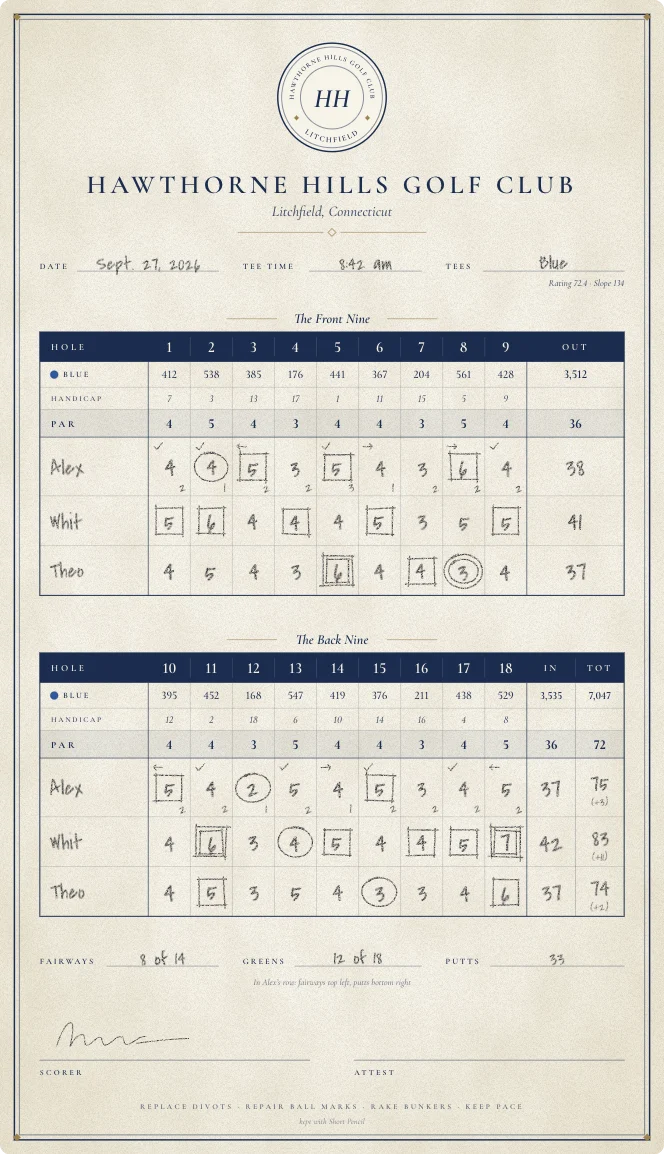
Above the table, a card’s header leaves room for the date and the tees you’re playing; the one above adds the tee time. The hole row is the easy one. Under it, each set of tees gets a row of yardages, and here you have to pick: find the tees you’re playing and ignore every other row. There’s no standard for tee colors. One course’s Blue is another’s Black, and some clubs name their tees, Championship or Forward, instead.
Your tee decides more than length. Par, rating and slope can change with it, so read the numbers beside your row: “Rating 72.4 · Slope 134” under the blue tees above.
Par
Par is the score a scratch golfer, someone with a Handicap Index of 0.0, is expected to make on a hole in normal conditions, allowing two putts. It’s set mostly by length, with difficulty as the tiebreaker. Under the World Handicap System’s guidance, a 470-yard hole for men or a 400-yard hole for women falls inside two ranges and can be a par 4 or a par 5 depending on how hard it plays, and par should be printed for men and women alongside every hole.
Par describes the hole, and your own target can sit well above it. A golfer who receives 18 strokes and makes 18 bogeys has shot net par, which is a good day.
The handicap row, or stroke index
The row labeled Handicap, Hcp or S.I. has nothing to do with your handicap. It ranks the holes from 1 to 18 for handicap strokes, so a golfer getting 10 strokes takes one on each of the holes ranked 1 to 10. Publishing that order, on the card or somewhere visible near the first tee, is the committee’s job under the Rules of Golf. Three things about it surprise people.
The club sets it, not the raters
In the US, the rating teams from the Allied Golf Associations can recommend an order based on course rating data, but the final ranking is the club’s decision. The ranking is about difficulty relative to par: the holes where a golfer is most likely to need a stroke get the lowest numbers. A long par 5 that plays easy for its par can carry a higher number than a short par 4 with water everywhere.
Odd numbers usually go on the front nine
The World Handicap System recommends odd stroke indexes on the front nine and even ones on the back, swapped if the back nine is significantly harder. A golfer receiving six strokes gets three going out and three coming home. The card above is set up that way.
The lowest numbers sit mid-nine
The same guidance puts stroke index 1 or 2 in the middle three holes of each nine, 3 or 4 in the first or last three, and avoids low numbers on consecutive holes. The reason is match play. Plenty of matches never reach the 18th, and a stroke waiting there is no use to anyone by then. On the card above, stroke index 1 is the 441-yard 5th, in the middle of the front nine.
A nine-hole course played twice for 18 needs 18 numbers for nine holes; Short Pencil’s answer is odd numbers the first time around and even the second.
Course rating and slope
You use these two numbers, printed for each set of tees and often separately for men and women, to turn a Handicap Index into strokes on a particular course. Officially, neither has anything to do with the stroke index.
Course rating is the score a scratch golfer is expected to shoot from those tees in normal conditions, given to one decimal place. A rating of 72.4 on a par-72 course means a scratch player should finish a fraction over par.
Slope measures how much harder the course plays for a bogey golfer, a Handicap Index of about 20 for men or 24 for women, than for a scratch golfer. It comes from the gap between the course rating and a second number, the bogey rating. A course of standard difficulty has a slope of 113, and slopes run from 55 to 155. A high slope means the course gets harder, faster, the more strokes you need; length is only part of it.
Raters work both out from each hole’s effective playing length (adjusted for roll, wind, elevation, altitude, doglegs and forced layups) and ten obstacle factors: topography, fairway, green target, recoverability and rough, bunkers, crossing obstacles, lateral obstacles, trees, green surface and, as a factor of its own, psychology.
The payoff is the Course Handicap formula: Index × Slope ÷ 113 + (Course Rating − Par). A golfer with a 9.4 index gets 12 strokes from the blue tees on the card above (9.4 × 134 ÷ 113 + 0.4 = 11.55) but only 9 on a course with a slope of 113 rated at par. That’s three strokes’ difference for the same golfer, all of it from the rating and slope in the corner of the card.
Out, In and Total
Out is the front nine, In the back nine, Tot or Total the round, and the same columns add up the yardage and par as well as your scores. On the card above, Alex goes out in 38 and comes home in 37 for 75.
The words come from links golf. The Old Course at St Andrews ran out from the town and back along the same narrow strip of land, and in 1764 the Society of St Andrews Golfers combined some of its short holes, turning a round of 22 holes, 11 out and 11 back, into 18. Many courses now loop back to the clubhouse after nine, but the card still says Out and In.
Some cards add two narrow columns after the total: Hcp for your handicap strokes and Net for the total minus them. In a competition you don’t have to fill them in. Since 2023, Rule 3.3b(4) has made the handicap and the adding up the committee’s job, unless it adopts Model Local Rule L-2, which puts showing your handicap back on you.
Signatures and local rules
The lines at the foot of the card are for certifying it: Marker and Player on some cards, Scorer and Attest on others. In a stroke-play competition, your marker and you both certify the card before it goes back to the committee, under Rule 3.3b. In a casual round they’re optional, and a good habit.
Turn a club’s card over and you’ll often find the local rules: where out of bounds is, how penalty areas are marked, and sometimes a short version of a Model Local Rule such as E-5, the two-stroke alternative to going back after a lost ball or one out of bounds. The Rules let committees publish them on the card, a notice board or the club’s website, and if the card carries a shorthand version, the full text should be available somewhere. Read them on the first tee, because they can change what you write in the box.
Short Pencil’s card keeps the same shape. There’s a Scorer line you sign with your finger, an Attest line for a playing partner and, where a club card would print its local rules, a line of house rules: replace divots, repair ball marks, rake bunkers, keep pace.
Read the card before the first tee shot. With the rating, the slope and the handicap row, you can work out in thirty seconds how many strokes you get, where they fall and what par means for you that day.
Questions
What does the handicap row on a golf scorecard mean?
It’s the stroke index: a ranking of the holes from 1 to 18 that sets the order in which handicap strokes are given. A golfer getting 10 strokes takes one on each hole ranked 1 to 10.
What is slope on a golf scorecard?
Slope rating measures how much harder a course plays for a bogey golfer than for a scratch golfer. A course of standard difficulty is 113, and slopes range from 55 to 155.
What is course rating in golf?
The score a scratch golfer, with a Handicap Index of 0.0, is expected to shoot from a set of tees in normal conditions, given to one decimal place, such as 72.4.
Is a higher slope rating harder?
Yes, for anyone who isn’t a scratch golfer. The higher the slope, the more strokes a higher handicapper receives there compared with a course of average slope.
What do Out and In mean on a golf scorecard?
Out is the total for the front nine and In the total for the back nine. The terms come from early links courses like the Old Course at St Andrews, which went out from the town and came back in.
Why are the odd handicap holes on the front nine?
The World Handicap System recommends odd stroke indexes on the front nine and even ones on the back so that handicap strokes are spread evenly through the round. A club can swap them if its back nine is significantly harder.
What do Hcp and Net mean on a scorecard?
On a player’s line, Hcp is the number of handicap strokes they receive and Net is their total score minus those strokes. In a competition, the committee works out both.