Guides · Scorecard guide
Tracking golf stats on your scorecard.
The four stats worth keeping, how to mark them in the corners of each box, what normal looks like, and which one to watch at your handicap.
October 28, 2026
A scratch golfer hits about ten greens in regulation in an average round. That figure comes from Arccos shot-tracking data, analyzed by Lou Stagner and published by Golf.com in February 2022, and it means a golfer who plays to par still misses eight greens a day. A 17-to-19 handicap, by the same numbers, hits about four.
You don’t need a sensor in every grip to find out where you sit. Four stats fit on an ordinary scorecard: three penciled into the corners of each box as you walk off the green, and a fourth worked out from numbers already there.
The short answer
Track four stats: fairways hit (par 4s and 5s only), greens in regulation, putts and penalty strokes. Mark them small in the corners of each box: a tick top left for a fairway or an arrow for the side you missed, P or P2 top right for penalty strokes, and the number of putts bottom right.
Greens need no mark. Subtract your putts from your score: if what’s left is par minus two or less, you hit the green in regulation. Total all four under your row before you sign.
Four stats a pencil can keep
The best stat in golf is one you can’t keep with a pencil. Strokes gained, which the PGA Tour adopted for putting in May 2011 from the work of Columbia Business School professor Mark Broadie, measures every shot against the average Tour result from the same distance. It needs the distance of every shot, which the Tour gets from its ShotLink tracking system and you don’t get from a scorecard.
Four simple stats do a different job. Three fit in the corners of the box without crowding the score, the fourth needs no writing, and together they cover the whole hole: tee shot, approach, green, trouble. One round shows you which part cost you strokes, and ten show you what to practice.
Fairways hit: par 4s and 5s only
A fairway counts when your tee shot on a par 4 or a par 5 comes to rest on the fairway, whatever club you hit. Par 3s never count, since you’re aiming at the green. A typical par-72 layout with four par 3s gives you 14 fairways to find, which is why you write the total as “8 of 14” rather than as a percentage of 18.
Put a tick in the top left corner for a fairway. For a miss, draw an arrow the way the ball went: ← for left, → for right. The circles and boxes around the score itself are in our guide to scorecard symbols.
The arrow is the valuable part. A fairway percentage tells you that you missed; a row of arrows tells you how, and five arrows pointing the same way is a pattern you can take to the range. Be strict about it, too. If the ball isn’t on the short grass, it isn’t a tick, and a first cut that “might as well be fairway” still gets an arrow.
Greens in regulation, worked out from the score
A green in regulation means your ball is on the putting green with two strokes to spare for par. That’s one stroke on a par 3, two on a par 4, three on a par 5; the two spare strokes are the two putts par assumes. It needs no mark of its own. Take your putts away from your score and what’s left is the strokes it took to reach the green, penalty strokes included, as they should be. If that’s par minus two or less, you were on in regulation. Six holes from the card below:
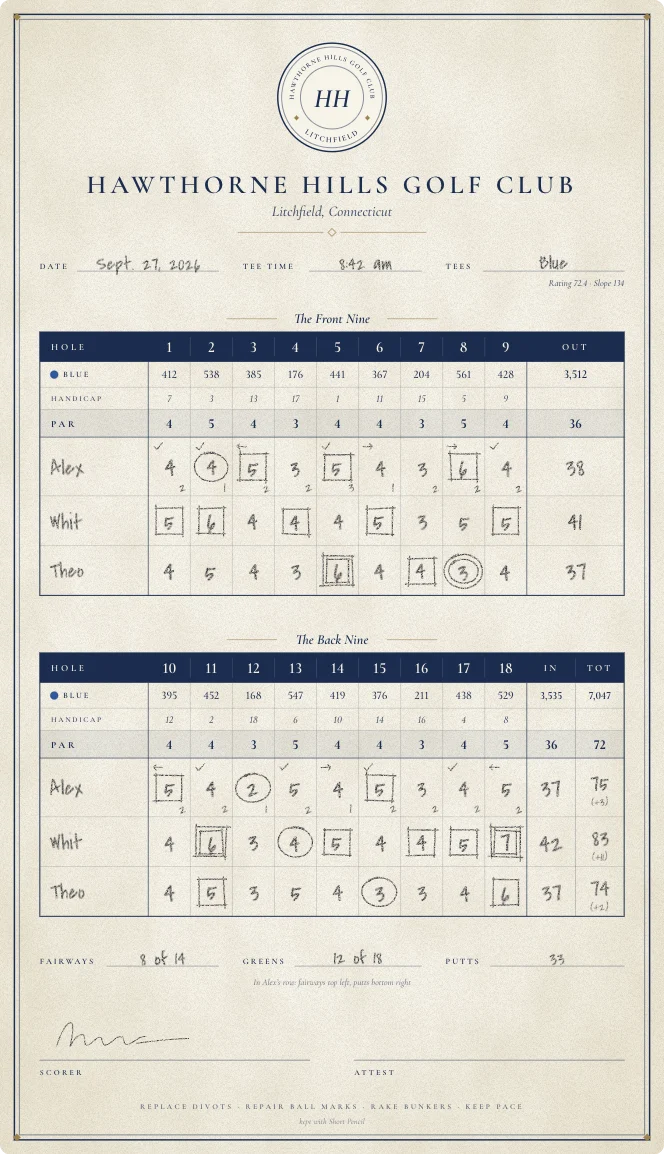
| Hole | Par | Score | Putts | Score minus putts | Green in regulation? |
|---|---|---|---|---|---|
| 1 | 4 | 4 | 2 | 2 | Yes |
| 3 | 4 | 5 | 2 | 3 | No |
| 4 | 3 | 3 | 2 | 1 | Yes |
| 5 | 4 | 5 | 3 | 2 | Yes, then three putts |
| 6 | 4 | 4 | 1 | 3 | No, saved with one putt |
| 8 | 5 | 6 | 2 | 4 | No |
Holes 5 and 6 are the ones to look at. On the 5th, the hardest hole on the course, Alex found the fairway, found the green and still made bogey. On the 6th he missed both and made par. With only the scores, you’d see a bogey and a par and nothing else.
Two rules keep the arithmetic honest:
- Only strokes on the putting green are putts. A putt from the fringe is a stroke from off the green. Count it as a putt and the sum hands you a green you missed.
- A chip-in means you missed the green. Hole out from off the green and your putts are zero, so score minus putts is the whole score, more than par minus two. That’s correct. An ace on a par 3 is the one hole-out that counts as a green.
Putts, and the trouble with counting them
Count every stroke you make on the putting green and write the number small in the bottom right corner. On the PGA Tour in 2026, through October 19, the average was 28.97 putts a round.
A putts total misleads on its own. Miss a green, chip to three feet and hole it: one putt. Hit the green from 180 yards and two-putt from 40 feet: two putts. Both are pars, and the putts column flatters the first. Arccos found a related effect in a 2017 analysis: even a three-putt rate mixes up approach play and putting, because higher handicaps leave their approaches farther from the hole.
Read putts next to greens for that reason, and of the putting numbers, watch the three-putts rather than the total. In that 2017 data, golfers with handicaps over 15 averaged 3.2 three-putts a round, double the 1.6 of a 1-to-5 handicap. A 3 in the bottom-right corner is the one putting number worth circling in your head.
Penalty strokes, and the optional up-and-down
Write P in the top right corner for one penalty stroke and P2 for two. The strokes are already in your score, as they always are on paper; the mark shows where they went. You can cut penalty strokes with better decisions, before you change your swing at all. A ball out of bounds costs you a stroke and the distance, whether it came from a bad swing or a driver you didn’t need to hit.
Up-and-downs are the one extra worth knowing, and they don’t need a fifth mark. The PGA Tour’s version, scrambling, is the share of missed greens on which a player still makes par or better; the Tour average in 2026 was 59.22% through October 19. Your card already holds it: any hole with no green in regulation and a score of par or better. On Alex’s card he missed six greens (3, 6, 8, 10, 14 and 15) and saved par on two of them, the 6th and the 14th.
We stop at three marks, on purpose. Greens and up-and-downs are already in the numbers, and a box with five notes in it stops reading as a score.
What normal looks like
Tour numbers are worth knowing mostly so you stop measuring yourself against them. In the 2026 season, through October 19, PGA Tour players averaged 61.95% of fairways, 66.73% of greens, 28.97 putts and 59.22% scrambling (pgatour.com stats). Set Tour greens per round beside the Arccos amateur figures from 2022:
| Who | Greens in regulation, average round |
|---|---|
| PGA Tour, 2026 | About 12 (66.73%) |
| Scratch amateurs | 10.1 |
| 5 to 7 handicap | 7.6 |
| 11 to 13 handicap | 5.3 |
| 17 to 19 handicap | 4.1 |
If you play off 18 and hit four greens, you’re average for your handicap. Measure against the row you’re in and the row above it, and judge your game by the trend over ten cards.
Which stat to watch at your handicap
Keep all four, but read one of them first. Our pick for each handicap range:
| Your handicap | Read first | Why |
|---|---|---|
| 20 and up | Penalties and three-putts | They turn bogeys into doubles, and they’re the quickest strokes to save. |
| 10 to 19 | Greens in regulation | The stat that moves scores most at this level. |
| Under 10 | Greens, then up-and-downs | You hit enough greens that the misses you save decide the round. |
Greens have the strongest evidence behind them. Stagner’s Arccos analysis, written up by Golf.com in March 2024, compared scores by greens hit and by fairways hit for 5, 10 and 15 handicaps, and greens mattered more at all three. For a 15 handicap, the greens gap was worth about eight strokes a round; the fairways gap, about three.
Fairways still earn their corner, for the arrows: a fairway percentage on its own rarely tells a mid-handicap what to do, and a row of arrows all pointing right gives you something to work on.
Totting them up
On paper, add the four under your row before you sign: fairways as “8 of 14”, greens as “12 of 18”, total putts, total penalty strokes. Keep last season’s cards and the averages are an evening with a calculator.
Short Pencil does the totting for you. Choose “Track putts, fairways & penalties” when you set up a round, or switch it on mid-round from the menu on the scoring screen, and on each hole you tap where the tee shot went (←, ✓ or →, with no fairway buttons on a par 3), your putts and any penalty strokes. The app dims counts your score can’t allow, so a 4 can’t carry four putts. It keeps stats for your own row, the first on the card.
The card pencils them into the corners of your boxes in the layout above and totals all four on a fill-in line above the signatures. The app works out greens from score minus putts and never asks you for them.
Start tracking on the 12th and the putts read “14 in 7”, so a partial count can’t pass for a full round. The round journal on the home screen then averages your putts per round, fairways and greens across your tracked 18-hole rounds, and the averages follow its filters, so you can see them for one course or one year.
Keep the four for ten rounds before you change anything about your game, then work on whatever repeats in the corners, the same arrow or the same 3.
Questions
What golf stats should I track?
Fairways hit on par 4s and 5s, greens in regulation, putts and penalty strokes. Together they cover the tee shot, the approach, the green and the trouble, and all four can be kept on an ordinary scorecard.
How do you calculate greens in regulation?
Subtract your putts from your score on the hole. If the result is par minus two or less (1 on a par 3, 2 on a par 4, 3 on a par 5), you hit the green in regulation.
Do par 3s count for fairways hit?
No. Fairways are only counted on par 4s and par 5s, where the tee shot is meant to find the fairway. On an 18-hole course with four par 3s there are 14 fairways to hit.
What is a good number of putts per round?
PGA Tour players averaged 28.97 putts a round in the 2026 season through October 19. Putts depend on how many greens you hit, so three-putts are a better measure of putting than the total.
Does a putt from the fringe count as a putt?
For working out greens in regulation, count only strokes made on the putting green as putts. A putt from the fringe is a stroke from off the green; counting it as a putt would credit you with a green you missed.
What is an up-and-down in golf?
Getting the ball in the hole in two strokes from off the green, one shot onto it and one putt. The PGA Tour’s related stat, scrambling, is the share of missed greens on which a player still makes par or better.