Guides · Scoring guide
How to keep score in Stableford.
Points for every hole, a points column on the card, the 95% handicap allowance, when to pick up, and the PGA Tour’s modified version.
October 23, 2026
On a par 4 where you get no handicap stroke, a 6 and an 11 are worth the same in Stableford: nothing. That was the idea from the start. Dr Frank Stableford worked out his system as a member of Wallasey Golf Club, in north-west England, so that a few bad holes no longer meant a torn-up card. The club dates the first competition played under it to May 16, 1932.
The short answer
Score each hole on your net score, your strokes minus any handicap strokes you get there, against par: 2 points for a net par, 1 for a net bogey, 3 for a net birdie, 4 for a net eagle, and 0 for a net double bogey or worse. Add up the points. The highest total wins.
Write your strokes in the box as usual and the points beside or under them. Over 18 holes, 36 points is what a net par on every hole would earn: you played to your handicap.
Points per hole
The table is Rule 21.1b. It compares your score with a “fixed target score” for each hole, which is par unless the Committee sets something else.
| Net score on the hole | Points |
|---|---|
| Double bogey or worse, or no score | 0 |
| Bogey | 1 |
| Par | 2 |
| Birdie | 3 |
| Eagle | 4 |
| Albatross | 5 |
| Four under par | 6 |
In a handicap Stableford, your strokes come off first and the table reads net. Get a stroke on a par 4 and a 5 is a net par, worth 2 points; a 4 there is a net birdie, worth 3. Get no stroke and the same 5 is a bogey, worth 1.
Points never go below zero. Rule 21.1c says so in as many words, even after penalty strokes.
Filling out the card with a points column
The Rules ask little of you. A hole that earns points needs your score on the card. A hole that earns none can show no score at all, or any score worth zero (Rule 21.1b(2)). Working out the points, and applying handicap strokes, is the Committee’s job. A competition can encourage you to write the points in, but it can’t require it.
Write them in anyway. The Rules’ own sample card, Diagram 21.1b, puts a Points row under the player’s scores, and it’s how you know where you stand on the 14th tee. Lay it out like this:
- The box: your gross score, the strokes you took.
- A dot in the corner: each hole where you get a handicap stroke, marked before you tee off.
- The points: in a spare row or column beside your score. Some club cards print one.
Write the strokes in every box, whatever else you do. Anyone can redo the points from them afterwards, but a stroke count nobody wrote down is gone.
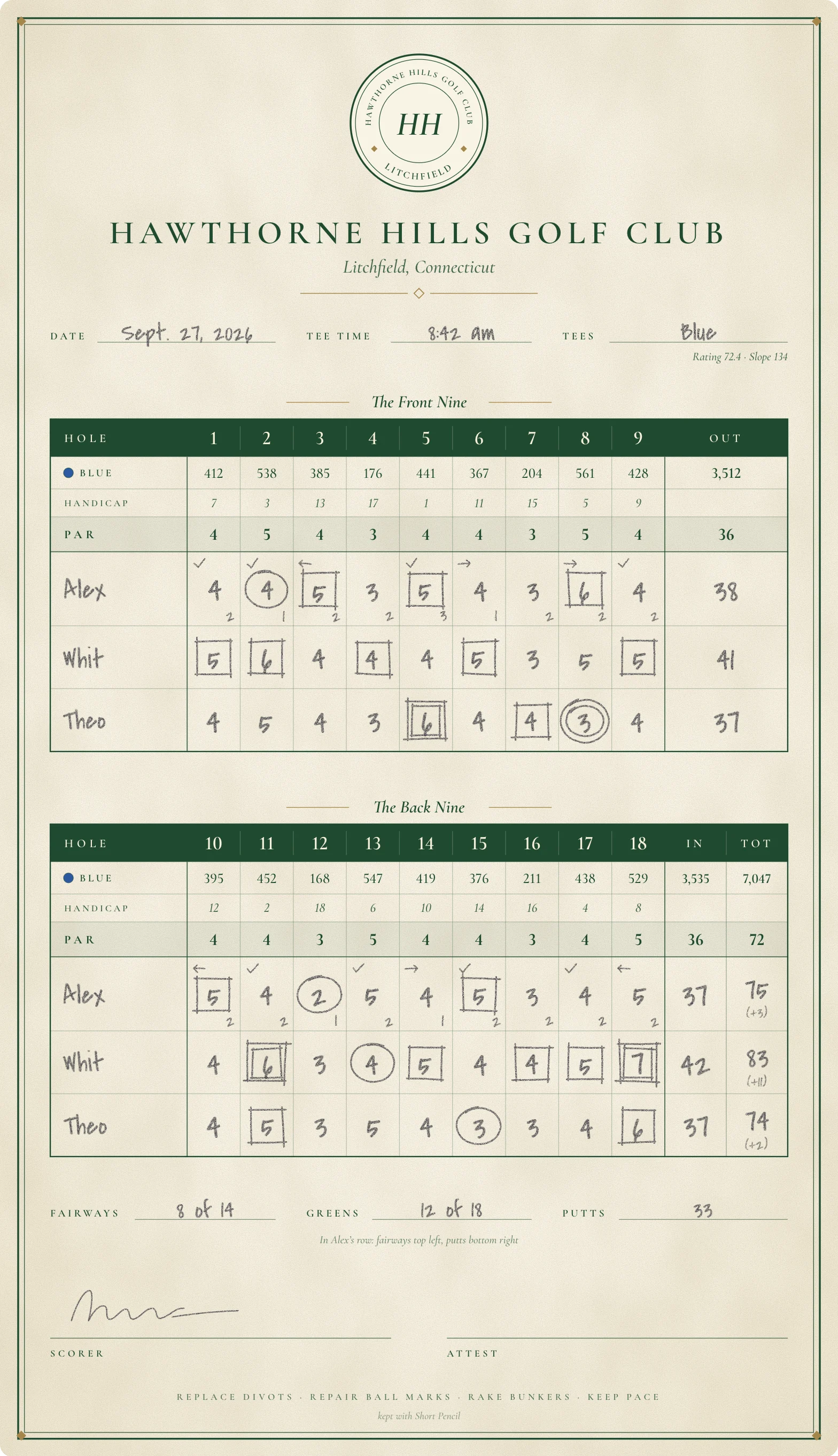
Take Whit’s row on the card above: 83 strokes off the blue tees, rated 72.4 with a slope of 134. Give Whit a Handicap Index of 9.4 and the Course Handicap comes out at 12. At 95%, the Playing Handicap is 11, so Whit gets a stroke on each hole with a handicap of 1 to 11. Whit’s back nine, with a points row:
| Hole | Par | Hcp | Whit | Stroke | Net | Points |
|---|---|---|---|---|---|---|
| 10 | 4 | 12 | 4 | 4 | 2 | |
| 11 | 4 | 2 | 6 | • | 5 | 1 |
| 12 | 3 | 18 | 3 | 3 | 2 | |
| 13 | 5 | 6 | 4 | • | 3 | 4 |
| 14 | 4 | 10 | 5 | • | 4 | 2 |
| 15 | 4 | 14 | 4 | 4 | 2 | |
| 16 | 3 | 16 | 4 | 4 | 1 | |
| 17 | 4 | 4 | 5 | • | 4 | 2 |
| 18 | 5 | 8 | 7 | • | 6 | 1 |
| In | 36 | 42 | 5 | 37 | 17 |
The 13th is the hole that matters. A birdie 4 on a par 5, with a stroke, is a net eagle and 4 points. The front nine adds 19 more, for 36: net 72 on a par-72 course, a net par round to the point.
Short Pencil keeps strokes and leaves the points to you. It writes the gross score in pencil and prints the course’s handicap row on the finished card, which is everything you need to add the points yourself.
Handicap strokes: 95%, then the stroke index
Start with your Course Handicap for the tees you’re playing: Handicap Index × Slope ÷ 113, plus the Course Rating minus par. The World Handicap System then recommends a 95% allowance for individual stroke play, Stableford included, in a field of 30 to 100 players. For a field under 30, the R&A says 100% could be considered. The result, rounded, is your Playing Handicap.
Those strokes go on the hardest holes first, in the order of the handicap (stroke index) row. Eleven strokes means one on each hole ranked 1 to 11. Twenty strokes means one on every hole and a second on the holes ranked 1 and 2.
Stableford’s zero starts at net double bogey, which is also the most any hole can count when you post a score for your handicap. The two agree on where a hole stops mattering.
Why a blow-up hole costs so little
In stroke play, every stroke on every hole lands in the total. In Stableford, one bad hole can cost you at most the 2 points a net par would have earned. Put a 10 on Whit’s card at the 18th instead of the 7: in a medal, that’s 86 instead of 83, three strokes gone. In Stableford it’s 35 points instead of 36, a single point.
The scale is lopsided on purpose: a hole can earn you 2 more points than par, sometimes more, but can only cost you 2. That’s the case for being braver in a Stableford than in a medal. It’s also why a Stableford total says less about how you played than a stroke total does. On par 4s where you get no stroke, a round with three 9s and a round with three 6s look alike in the points column.
Picking up when you can’t score
Rule 21.1b encourages it. Once your score will earn zero points, you can stop, and the hole counts as completed. Not holing out is a disqualification in ordinary stroke play under Rule 3.3c; in Stableford it means zero points for the hole (Rule 21.1c).
Work out your pick-up number on the tee: par, plus 1, plus any strokes you get. On a par 4 where you get a stroke, it’s 6. If you’ve played six strokes and the ball still isn’t in the hole, the best you can make is a 7, a net double bogey and zero points. Pick it up and walk on.
On the card, draw a dash. The Rules accept no score or any number worth zero, but a dash tells everyone you picked up rather than forgot. For your handicap record, the hole goes in at your most likely score, never more than net double bogey.
Modified Stableford
Modified Stableford flips the scoring so that par is worth nothing and mistakes cost you points. This is the table the Barracuda Championship used, scored on gross strokes against par:
| Score on the hole | Points |
|---|---|
| Albatross | +8 |
| Eagle | +5 |
| Birdie | +2 |
| Par | 0 |
| Bogey | −1 |
| Double bogey or worse | −3 |
The PGA Tour used a modified Stableford at The International, at Castle Pines in Colorado, from 1986 to 2006. Its Reno–Tahoe stop, called the Barracuda Championship from 2014, played under the table above from 2012 through 2025. Nick Dunlap won the 2024 Barracuda with 49 points, 19 of them from a bogey-free closing 62. The tournament lost its title sponsor after 2025 and wasn’t on the 2026 PGA Tour schedule.
Two numbers explain the format. A birdie is worth twice what a bogey costs, so six birdies, four bogeys and a double (+5) beat 17 pars and a birdie (+2), though the first round is a stroke worse. And the cap still holds: an 8 on a par 4 costs 3 points, the same as a 6. Totals can go below zero, and on a hard day they do.
The modified table isn’t part of Rule 21.1. Events that use it publish their own, so read the sheet. For a club game with handicaps, we’d stick with the standard table, which already evens the field out. Save the modified one for players who expect to make birdies.
Before your next Stableford, put a dot on every hole where you get a stroke and work out each pick-up number on the tee. Then, the first time a hole runs away from you, pocket the ball at that number and walk to the next tee with the round still worth playing.
Questions
How do you keep score in Stableford?
Score each hole on your net score against par: 0 points for a net double bogey or worse, 1 for a net bogey, 2 for a net par, 3 for a net birdie, 4 for a net eagle and 5 for a net albatross. Add up the points for the round; the highest total wins.
What is a good Stableford score?
36 points over 18 holes is what a net par on every hole earns, which is playing to your handicap. Anything above 36 means you beat it.
What handicap allowance is used in Stableford?
The World Handicap System recommends 95% of your Course Handicap for individual Stableford in fields of 30 to 100 players. For a field of fewer than 30, a Committee may use 100%.
Can you pick up in Stableford?
Yes. Rule 21.1b encourages you to stop once your score can only earn zero points. There is no penalty; you score zero for the hole.
What is modified Stableford?
A points table that rewards gross scores against par: +8 for an albatross, +5 for an eagle, +2 for a birdie, 0 for a par, −1 for a bogey and −3 for a double bogey or worse. The PGA Tour used modified Stableford at The International from 1986 to 2006 and at its Reno–Tahoe event, the Barracuda Championship, from 2012 to 2025.
Can you post a Stableford score for your handicap?
Yes. Holes you finished go in at their actual score, capped at net double bogey. Holes where you picked up go in at your most likely score, which also can’t be more than net double bogey.