Guides · Scoring guide
Handicap strokes and net scores.
How a Handicap Index turns into strokes on particular holes, how to mark them, and how to work out a net score hole by hole.
October 22, 2026
A golfer with a 9.4 Handicap Index doesn’t get nine strokes. From the blue tees on the card below, rated 72.4 with a slope of 134, the same golfer gets 12, and in a club stroke-play competition plays off 11. The index is only where the arithmetic starts. The course, the tees and the format turn it into strokes, and the handicap row on the card decides which holes they land on.
Here’s the whole chain worked through on one card: the three handicap numbers, where each stroke goes, how to mark them, net scores hole by hole, plus handicaps, and the cap that applies when you post the round.
The short answer
Turn your Handicap Index into a Course Handicap for the tees you’re playing: Index × Slope ÷ 113 + (Course Rating − Par). Apply the format’s allowance, 95% for individual stroke play, to get your Playing Handicap. Then take one stroke on every hole whose handicap number (the stroke index) is at or below your Playing Handicap. Above 18, every hole gets one and the count starts again at 1.
Write your gross score in each box. Your net score on a hole is the gross minus the strokes you get there, and your net total is your gross total minus your Playing Handicap.
Three numbers, one round
The handicap you quote in the bar is your Handicap Index. It’s the average of the lowest 8 of your most recent 20 Score Differentials, measured against a course of standard difficulty: one with a slope of 113. It travels with you from course to course. It isn’t a number of strokes.
Two conversions happen before you tee off. Take Whit, one of the three players on the sample card below, and give Whit a Handicap Index of 9.4 on the blue tees: course rating 72.4, slope 134, par 72.
| Number | How it’s worked out | Whit, blue tees |
|---|---|---|
| Handicap Index | Lowest 8 of your last 20 Score Differentials | 9.4 |
| Course Handicap | Index × Slope ÷ 113 + (Course Rating − Par) | 9.4 × 134 ÷ 113 + 0.4 = 11.55, so 12 |
| Playing Handicap | Course Handicap × the format’s allowance | 11.55 × 95% = 10.97, so 11 |
Notice the order. The allowance is applied to the unrounded Course Handicap, and the answer is rounded once, at the end. The World Handicap System says rounding twice gives a noticeably different answer about a quarter of the time. Here it happens not to matter (12 × 95% is 11.4, which also rounds to 11), but on another day it will.
The allowance depends on the format. The recommended ones:
- Individual stroke play: 95%, for a field of 30 to 100 players.
- Four-ball stroke play: 85%.
- Singles match play: 100%. The lower player plays off zero and the other gets the difference. If Whit (Course Handicap 12) plays Theo (5), Theo gets nothing and Whit gets 7 strokes, on the holes ranked 1 to 7.
- Four-ball match play: 90%, again of the difference from the lowest player.
In a casual round nobody sets terms, so agree the allowance on the first tee, before anyone has a reason to argue about it.
The handicap row decides where they go
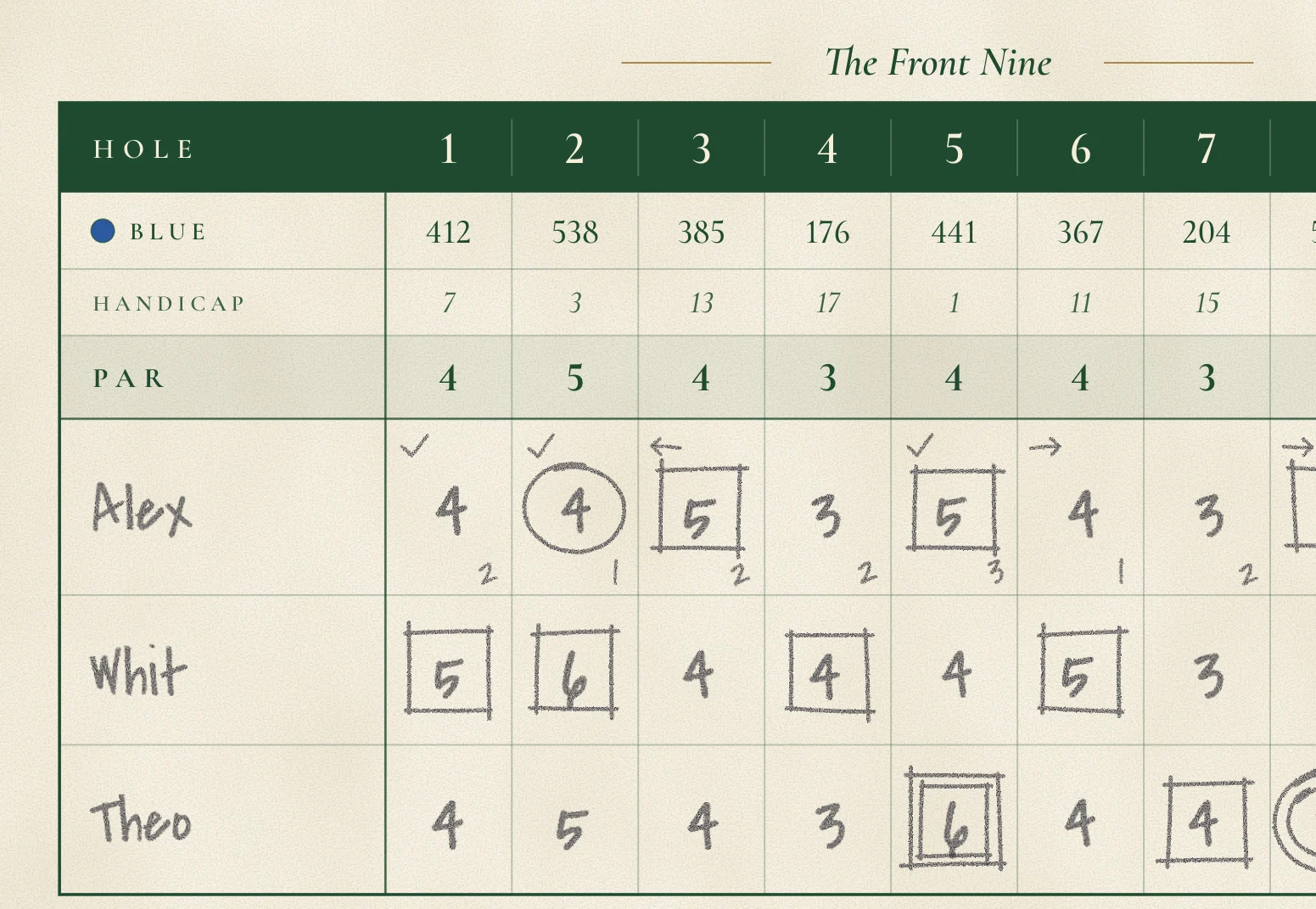
The row labeled Handicap (or Hcp, or S.I.) ranks the holes from 1 to 18, and strokes go out in that order. Whit’s 11 means a stroke on each hole ranked 1 to 11.
On this card that’s the 1st, 2nd, 5th, 6th, 8th and 9th going out, and the 11th, 13th, 14th, 17th and 18th coming home. Six strokes on the front, five on the back. That’s the usual pattern, not a quirk: clubs typically put the odd stroke indexes on the front nine, so an odd handicap gets its extra stroke on the way out.
Past 18, every hole gets a stroke and the count starts over. A Playing Handicap of 22 gets two strokes on the holes ranked 1 to 4 (here the 5th, 11th, 2nd and 17th) and one everywhere else. At 37, stroke index 1 gets three.
Dots and pops
Do the allocation once, on the first tee, and mark it. The usual way is a small dot in the corner of each box where you get a stroke, and two dots where you get two. Golfers call them dots, or pops. From then on, every score you write carries its own adjustment and you never have to look back at the handicap row.
Mark them before you play, not when you need them: in a match, a dot on a long par 4 can turn a bogey into a half, and you want to know that standing on the tee. And keep them in the corner. The number in the box is always the gross score, the strokes you actually took. In a competition, Rule 3.3b(1) has your marker enter the gross score, and Rule 3.3b(4) makes the handicap arithmetic the committee’s job, not yours.
The dots are for you. The number is for everyone.
Net score, hole by hole
Here’s Whit’s front nine from the sample card, playing off 11.
| Hole | Par | Stroke index | Strokes | Gross | Net |
|---|---|---|---|---|---|
| 1 | 4 | 7 | 1 | 5 | 4 |
| 2 | 5 | 3 | 1 | 6 | 5 |
| 3 | 4 | 13 | 0 | 4 | 4 |
| 4 | 3 | 17 | 0 | 4 | 4 |
| 5 | 4 | 1 | 1 | 4 | 3 |
| 6 | 4 | 11 | 1 | 5 | 4 |
| 7 | 3 | 15 | 0 | 3 | 3 |
| 8 | 5 | 5 | 1 | 5 | 4 |
| 9 | 4 | 9 | 1 | 5 | 4 |
| Out | 36 | 6 | 41 | 35 |
Five over par gross, one under net. The par on the 5th, the hardest-ranked hole on the course, is a net birdie, and so is the par on the 8th. The 4 on the par-3 4th, where there’s no stroke, is a bogey either way. Of the five boxed bogeys going out, four turn into net pars.
Over 18 holes Whit shot 83. Minus 11: net 72, level par.
That’s a good day, not an average one. The index is built from the best 8 of the last 20 rounds, so a net par means playing to your potential. And in an individual medal, the committee doesn’t need the hole-by-hole net at all: your net total is just the gross total minus your Playing Handicap. The stroke index only matters in formats that score hole by hole, like four-ball, Stableford and match play, and when you post the round.
Plus handicaps: giving strokes back
A golfer better than scratch has a plus handicap, written with a + sign, and gives strokes back to the course instead of receiving them. They start at the other end of the row. A Playing Handicap of +2 adds a stroke at stroke index 18 and 17, which on this card are the par-3 12th and the par-3 4th.
So a gross 3 on either hole is a net 4, and a +2 who shoots 70 has a net 72. The dot becomes a debt.
Posting the score: net double bogey
When you post the round for your handicap, each hole is capped at net double bogey: par, plus two, plus any strokes you receive there. A plus handicap subtracts the strokes it gives back. Until you have a Handicap Index, the cap is simply par plus five. Posting hole by hole applies the cap automatically; post a total and you adjust it yourself.
The catch is which handicap. For the cap, the Rules of Handicapping use your full Course Handicap, not the Playing Handicap from the competition.
So Whit, who played off 11 in the medal, posts off a Course Handicap of 12. The 10th, stroke index 12, carries a stroke for posting, and its cap is 7 rather than 6. Had Whit run up a 9 on the par-5 2nd, the cap there would be 5 + 2 + 1 = 8: the posted score uses an 8, and the medal still counts the 9. The cap protects your handicap from one bad hole; it doesn’t rewrite the card.
Short Pencil prints each hole’s handicap number on the card and writes the gross score in every box. It doesn’t calculate handicaps or net scores; that sum is yours.
Work it out once, before the first drive: index to Course Handicap to Playing Handicap, then dots down the row. After that, every box tells you two things at a glance, what you made and what it was worth, and you’ll know where your round stands long before anyone adds it up.
Questions
How do you use a golf handicap on a scorecard?
Convert your Handicap Index to a Course Handicap for your tees, apply the format’s allowance to get your Playing Handicap, then take one stroke on each hole whose stroke index is at or below that number. Mark those holes with a dot, write your gross score in each box, and subtract the strokes for your net score.
How do I know which holes I get strokes on?
Use the handicap (stroke index) row. With a Playing Handicap of 11, you get a stroke on the holes ranked 1 to 11. Above 18, you get one on every hole and a second starting again from stroke index 1.
What is a net score in golf?
Your gross score, the strokes you actually took, minus your handicap strokes. On a hole it’s the gross minus the strokes you get there; for the round it’s your gross total minus your Playing Handicap.
What does a dot on a golf scorecard mean?
A dot in the corner of a box marks a hole where the player receives a handicap stroke. Two dots mean two strokes. Golfers also call them pops.
What is net double bogey?
The maximum hole score for handicap posting: par plus two plus any strokes you receive on the hole, based on your full Course Handicap. Before you have a Handicap Index, the maximum is par plus five.
How do plus handicaps work on a scorecard?
A plus handicap gives strokes back, starting at stroke index 18. A Playing Handicap of +2 adds one stroke to the score on the holes ranked 18 and 17.
Do you write gross or net scores on a golf scorecard?
Gross. The box holds the strokes you actually took, and handicap strokes are shown separately, usually as dots. In a competition, the committee applies the handicap.