Guides · Scoring guide
Keeping score for 9 holes.
The nine-hole card, a nine played twice, what a good score looks like, handicap strokes over nine, and how 9-hole scores count since 2024.
November 8, 2026
Shoot 41 for nine holes off a 14.0 Handicap Index and the handicap system won’t double it. Since January 2024, the World Handicap System in the US has turned a nine-hole score into an 18-hole Score Differential by pairing it with the score the system expects you to make on the nine you didn’t play. A good nine gets a little less credit than doubling it would give, and a bad one does a little less damage.
The short answer
Write your strokes for each of the nine holes, penalty strokes included, and add them up for one total. If it’s the front nine of an 18-hole card, that total goes in the Out box. Go round a nine-hole course twice and you’ve played 18: the second time round is your back nine, with its own In total.
For your handicap, post it as a 9-hole score. You must play all nine holes, and the World Handicap System turns the round into an 18-hole Score Differential using an expected score, based on your Handicap Index, for the other nine.
The nine-hole card
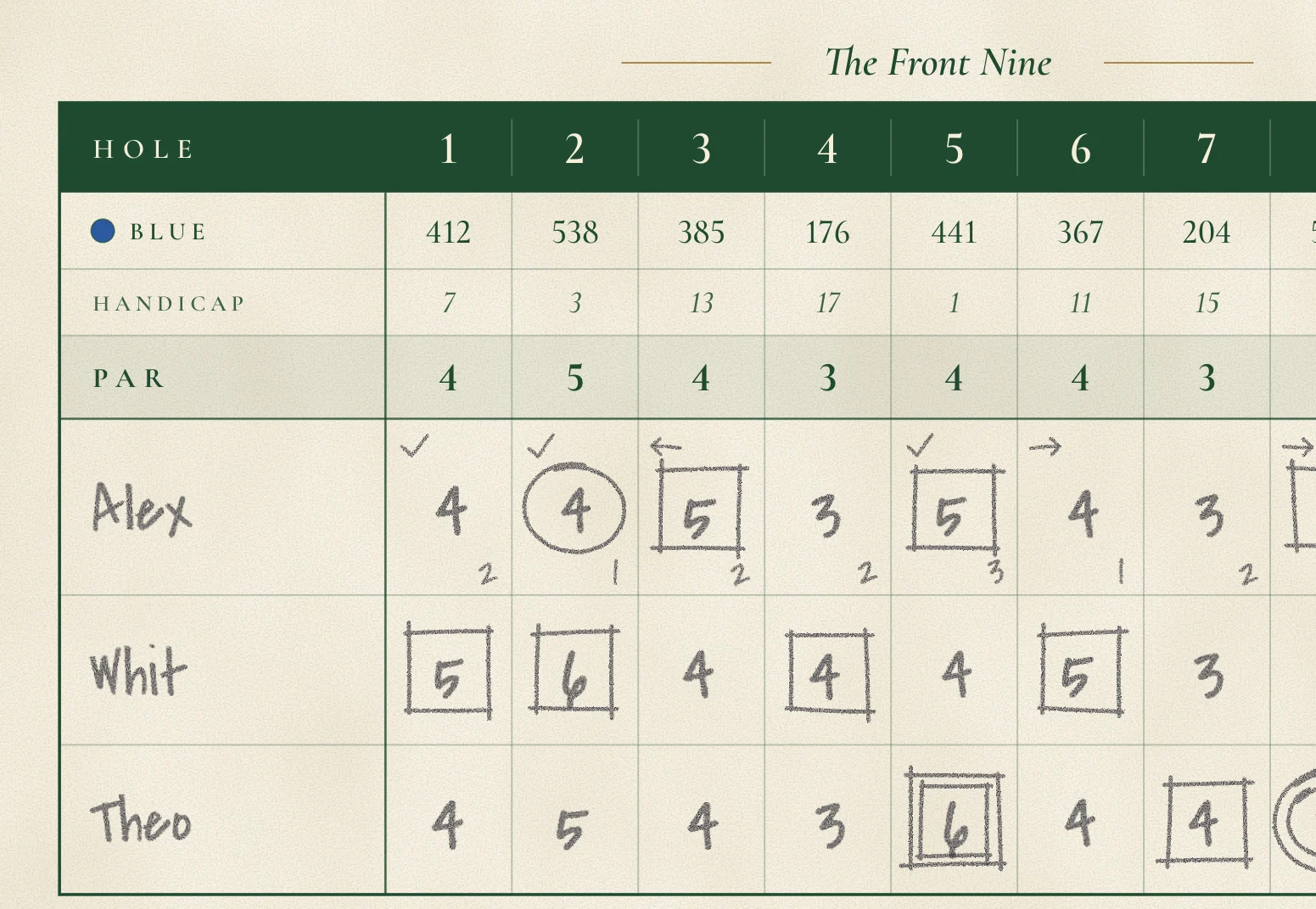
You score nine holes the same way as eighteen. Count every stroke until the ball is in the hole, add any penalty strokes, and write the number in your row. Our guide to keeping score in golf covers what counts as a stroke.
The box for the total depends on the card: a nine-hole course’s card has one total, and on an 18-hole card a front nine adds up into Out and a back nine into In.
Look at the handicap row before you start. On an 18-hole card, a single nine doesn’t carry the numbers 1 to 9. The front nine above has only odd ones, the pattern the World Handicap System recommends: odd stroke indexes going out, even ones coming home. That matters as soon as you take handicap strokes.
Short Pencil prints a nine-hole round as a single table titled The Nine, with one Total column. An 18-hole card gets The Front Nine with Out, and The Back Nine with In and Tot.
A nine-hole course played twice
At a nine-hole course, eighteen holes means going round twice. Score it as one 18-hole round: the first trip round is holes 1 to 9 and goes in Out, the second is holes 10 to 18 and goes in In.
The handicap row is the catch. A card that ranks its nine holes 1 to 9 has only nine numbers, and an 18-hole round needs eighteen. If the club publishes a full 1 to 18 order for two trips round, use it. If it doesn’t, the tidy answer is odd numbers the first time round and even numbers the second:
| Hole’s rank on the nine | First time round | Second time round |
|---|---|---|
| 1 | 1 | 2 |
| 2 | 3 | 4 |
| 3 | 5 | 6 |
| 4 | 7 | 8 |
| 5 | 9 | 10 |
| 6 to 9 | 11, 13, 15, 17 | 12, 14, 16, 18 |
A golfer receiving 7 strokes then takes them on the holes ranked 1 to 4 on the nine the first time round, and 1 to 3 the second: four going out, three coming home, and one on the hardest hole both times.
Short Pencil numbers the holes that way. Pick a nine-hole course and the round starts as nine holes; switch it to 18 and the card lists the nine twice, with the yardages repeated and, when the course ranks its holes 1 to 9, odd handicaps on the first trip and even on the second. If a hole’s par isn’t known, you set it once from the tee sign and both trips get it.
What’s a good score for nine holes?
Against par, the milestones are easy to work out. On a par-36 nine:
| Score for nine | What it means |
|---|---|
| 36 | Level par |
| 39 | Three over: under-80 pace for eighteen |
| 45 | A bogey on every hole |
| 47 | About half the average 18-hole score of US golfers |
| 54 | A double bogey on every hole |
The 47 comes from the National Golf Foundation, which puts the average 18-hole score of American golfers at about 94. Golfers who keep a handicap tend to play more often and score better: the USGA’s average Handicap Index is 14.2 for men and 28.7 for women, as Golf.com reported in September 2024.
A better test than par is your handicap. On a nine of standard difficulty, rated 36.0 with a slope of 113 and a par of 36, a 14.0 Index gets 7 strokes, so net par is 43. The USGA’s worked example, in the posting section below, implies that the system expects the same golfer to produce a 9-hole Score Differential of about 8.5 there, which is a score of 44 or 45.
That makes 43 a good nine for a 14 and 45 an ordinary one. Judge your nine against net par.
Handicap strokes over nine holes
There’s no separate 9-hole handicap. You have one Handicap Index, and for nine holes you halve it before converting it for the tees you’re playing (Rule 6.1b):
9-hole Course Handicap = (Handicap Index ÷ 2) × (Slope Rating ÷ 113) + (Course Rating − Par)
Use the rating, slope and par for those nine holes, not the 18-hole figures. In the USGA’s example, an 8.7 Index on a nine rated 35.3 with a slope of 121 and a par of 36 gets a 9-hole Course Handicap of 4. For how Course Handicaps work over eighteen, and what to do with them on the card, see our guide to handicap strokes and net scores.
On nine holes of an 18-hole course, the strokes go in ascending order of the course’s published 18-hole stroke index. A golfer with a 9-hole Course Handicap of 4 on the front nine pictured above takes strokes on the holes ranked 1, 3, 5 and 7: the 5th, the 2nd, the 8th (out of the picture) and the 1st.
Posting a nine for your handicap
Under the 2024 rules, a 9-hole score is acceptable when you play all nine holes on a nine with its own Course Rating and Slope Rating. Before 2024 the minimum was seven holes, and the score sat in your record until the system could combine it with a second nine.
Now it counts by the next day. The system works out a 9-hole Score Differential:
(113 ÷ 9-hole Slope Rating) × (9-hole Adjusted Gross Score − 9-hole Course Rating − half the PCC)
Then it adds your expected Score Differential for nine holes, which depends only on your Handicap Index, not on the course or how you played. The USGA’s example: a 14.0 Index posts 41, for a 9-hole differential of 7.2, and the 18-hole Score Differential comes out at 15.7. Doubling the 7.2 would have given 14.4.
Doubling a nine assumes a hot start would have carried on for eighteen holes. The USGA says golfers play to their Handicap Index only about 20 to 25% of the time, so indexes built that way would drift too low.
Two more cases:
- No Index yet. Nine-hole scores count toward the 54 holes you need for a first Index, in any mix with 18-hole rounds. The expected score comes in only once your first Index exists, and until then each hole is capped at par plus 5.
- Ten to seventeen holes. If you stop for a valid reason, such as darkness or weather that halts play, post hole by hole. The system fills the holes you didn’t play with your expected score and gives you an 18-hole differential.
Short Pencil doesn’t calculate handicaps, but it keeps every nine-hole card in your round journal. Your average and your row of recent totals come from full 18-hole rounds only; sort the journal by best score and it compares rounds against par scaled to 18 holes, so a nine sits fairly beside an eighteen.
Next time there’s only an hour of light left, play the nine and post it. Since 2024 it counts the next morning, and a short evening round goes into your Index like any other.
Questions
How do you keep score for 9 holes of golf?
Count every stroke on each hole, penalty strokes included, write the number under the hole, and add the nine for one total. On an 18-hole card, a front-nine total goes in the Out box and a back-nine total in the In box.
What is a good score for 9 holes of golf?
On a par-36 nine, 45 is bogey golf. The National Golf Foundation puts the average American score at about 94 for 18 holes, or 47 a nine.
Can you post a 9-hole score for your handicap?
Yes, if you play all nine holes on a nine with its own Course Rating and Slope Rating. Since January 2024 the World Handicap System turns it into an 18-hole Score Differential using an expected score for the other nine, and it counts toward your Index the next day.
How do you calculate a 9-hole handicap?
Halve your Handicap Index, multiply by the nine’s Slope Rating divided by 113, and add the nine’s Course Rating minus its par. That’s your 9-hole Course Handicap.
How do handicap holes work when you play a 9-hole course twice?
Use the club’s 1 to 18 order if it publishes one. Otherwise, one approach, and the one Short Pencil uses, is odd stroke indexes the first time round and even ones the second, so the hardest hole is ranked 1 going out and 2 coming home.
Do you have to play all 9 holes to post a 9-hole score?
Yes. Since the 2024 revision of the Rules of Handicapping, you must play all nine holes. The old minimum was seven.