Guides · Game guide
How to play skins.
One skin a hole, carryovers, validation and net skins, with a full sample round tallied hole by hole.
November 3, 2026
Whit shot 83 on the card below, eight strokes worse than anyone else in his group, and won three skins on one hole with a par. Every hole in skins is its own contest: a tie sends the prize on to the next hole, and the total at the bottom of the card decides nothing.
The short answer
Each hole is worth one skin. The player with the lowest score on the hole wins it, but only outright: if two or more players tie for low, nobody wins and the skin carries over, so the next hole is worth two. Most skins at the end of the round wins.
On the card, write every player’s gross score as usual. Under the rows, keep one line for the skins: the winner of each hole and how many skins it was worth, or “carry”.
How skins works
Skins is a hole-by-hole contest for any number of players. On each hole you compare everyone’s score, and a score has to be lower than all the others to win. Two players tying for low kill the skin, even if the third made a triple.
It works from two players up and is at its best with three or four, where ties come often enough to build carryovers but not so often that nobody wins. Agree these on the 1st tee:
- Gross or net. Net uses handicap strokes from the card’s handicap row (see below).
- What a skin is worth. Usually every hole the same. The televised Skins Game raised the value as the round went on: in its later years, $25,000 a hole on the first six and $200,000 on the 18th.
- Carryovers or not. The standard game carries. Some groups, especially in big fields, play without them, and a tied hole’s skin is dead.
- The 18th. The rule for skins still unclaimed when the round ends.
- Validation. Whether a skin has to be confirmed on the next hole.
The sample round, skin by skin
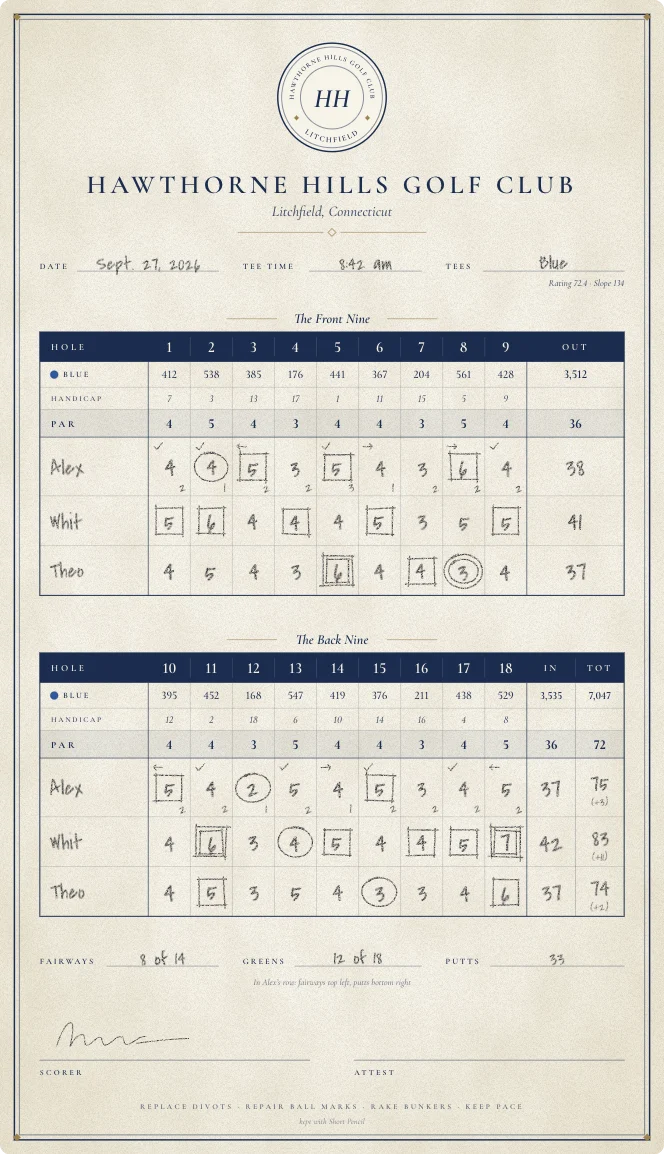
The card above played as gross skins, one skin a hole, carryovers on:
| Hole | Par | Alex | Whit | Theo | Skins |
|---|---|---|---|---|---|
| 1 | 4 | 4 | 5 | 4 | Carry |
| 2 | 5 | 4 | 6 | 5 | Alex, 2 |
| 3 | 4 | 5 | 4 | 4 | Carry |
| 4 | 3 | 3 | 4 | 3 | Carry |
| 5 | 4 | 5 | 4 | 6 | Whit, 3 |
| 6 | 4 | 4 | 5 | 4 | Carry |
| 7 | 3 | 3 | 3 | 4 | Carry |
| 8 | 5 | 6 | 5 | 3 | Theo, 3 |
| 9 | 4 | 4 | 5 | 4 | Carry |
| 10 | 4 | 5 | 4 | 4 | Carry |
| 11 | 4 | 4 | 6 | 5 | Alex, 3 |
| 12 | 3 | 2 | 3 | 3 | Alex, 1 |
| 13 | 5 | 5 | 4 | 5 | Whit, 1 |
| 14 | 4 | 4 | 5 | 4 | Carry |
| 15 | 4 | 5 | 4 | 3 | Theo, 2 |
| 16 | 3 | 3 | 4 | 3 | Carry |
| 17 | 4 | 4 | 5 | 4 | Carry |
| 18 | 5 | 5 | 7 | 6 | Alex, 3 |
| Skins | 9 | 4 | 5 |
The group tied for low on ten of the 18 holes, and somebody won every one of those skins later. Theo shot the best round and played the best hole of the day, an eagle 3 on the 8th, and won five. Six of Alex’s nine came from two pars, on the 11th and the 18th, each worth three because the group had tied the holes before them.
A par nobody matches can be worth more than an eagle, so skins suits groups of mixed ability. You can play steadily all day and collect nothing unless you beat everyone outright somewhere, and Whit still won two holes outright with his 83.
Carryovers, and what happens on the 18th
The televised Skins Game ran on carryovers. The first, at Desert Highlands in Scottsdale, Arizona, in 1983, put Jack Nicklaus, Arnold Palmer, Gary Player and Tom Watson against each other for $360,000. A tie on the 16th left $150,000 riding on the 17th, and Player took it with the only birdie. The event became a Thanksgiving weekend fixture until 2008, and Fred Couples won it five times.
The PGA Tour brought it back on Black Friday 2025, at Panther National in Florida. Keegan Bradley’s 7-foot putt on the 13th won $900,000, because the players had tied the three holes before it, and he finished with 11 skins and $2.1 million.
Your game needs a rule for the end of the round, because the 18th can be tied too:
- Play off. The Skins Game played extra holes until somebody won what was left.
- Split them. Share the unclaimed skins among everyone, or among the players who tied the 18th.
- Let them lapse. Nobody wins them.
Pick one before the 1st tee, because by the 18th green somebody already knows which rule pays them.
Validation: keeping a skin on the next hole
In the validation variant, the winner of a hole collects only by also tying or beating the low score on the next hole. Fail, and the skins go back into the pot and carry on.
The Skins Game tried it once, in 2001 at Landmark Golf Club in Indio, California. Greg Norman won the 17th, protected those skins with a par on the 18th, and took the rest in a playoff: the only player ever to sweep the whole purse, $1 million. Organizers had dropped the rule by the next year.
Run it on the sample card’s front nine and you can see why:
| Hole | Low score | Standard skins | With validation |
|---|---|---|---|
| 1 | Alex, Theo 4 | Carry | Carry |
| 2 | Alex 4 | Alex wins 2 | Alex wins 2, must validate |
| 3 | Whit, Theo 4 | Carry | Alex makes 5: not validated, 3 in the pot |
| 4 | Alex, Theo 3 | Carry | Carry, 4 in the pot |
| 5 | Whit 4 | Whit wins 3 | Whit wins 5, must validate |
| 6 | Alex, Theo 4 | Carry | Whit makes 5: not validated, 6 in the pot |
| 7 | Alex, Whit 3 | Carry | Carry, 7 in the pot |
| 8 | Theo 3 | Theo wins 3 | Theo wins 8, must validate |
| 9 | Alex, Theo 4 | Carry | Theo ties the low: 8 skins kept |
Standard skins splits the front nine three ways: Alex 2, Whit 3, Theo 3, with the 9th carrying. With validation, Theo takes all eight with an eagle and a par, and the 9th still carries into the back nine. It rewards the player who follows a great hole with a solid one, and it piles the skins into fewer, bigger pots.
Our view: play it once for the novelty, then go back to the standard game. The Skins Game’s organizers came to the same verdict after one year.
Net skins
Net skins uses the same rules on net scores. Each player takes strokes on the holes the card’s handicap row ranks hardest (a player getting 11 strokes takes one on each hole ranked 1 to 11), and the lowest net score wins the hole outright, or it carries. Nothing in the Rules or the World Handicap System sets an allowance for skins, so the group decides: full strokes for everyone, or strokes off the lowest handicap, as in a match. Our guide to handicap strokes covers the dots.
Before you agree, know that strokes in skins mostly buy ties. Give Whit 11 strokes on the sample card, the number our Stableford guide uses for him. His dots turn the 1st, 6th, 9th, 14th and 17th into three-way ties, and not one skin changes hands. A stroke wins you a skin only when it takes your net score below everyone else’s, and none of Whit’s does: the two holes he wins net, the 5th and the 13th, he had already won gross.
Keeping the tally
A skins tally needs one line. Under the players’ rows, write the winner’s initial and the number of skins for every hole that’s won, and a “c” for a carry. Say the pot out loud on each tee, “three on this one”, and nobody loses count.
Keep the gross scores in the boxes, untouched. You settle every skin from them, and if two players remember the 14th differently, the card is the only record. Our guide to keeping score for a group covers agreeing every number on the walk to the next tee.
Short Pencil doesn’t keep a skins tally. It keeps up to four players’ gross scores on one phone, hole by hole, with the course’s handicap row printed on the card and every birdie circled, so you can settle the skins from the finished card in a minute. It doesn’t place handicap dots or work out net scores, so mark those yourself if you play net.
Next time your group plays skins, settle three things on the 1st tee: gross or net, what happens to a tied 18th, and whether skins must be validated. Then, after two tied holes, play the next one for the outright win, since it’s worth three skins.
Questions
How do skins work in golf?
Each hole is worth a skin, won by the player with the lowest score outright. If the lowest score is tied, the skin carries over and the next hole is worth two. The player with the most skins at the end wins.
What happens if the 18th hole is tied in skins?
Agree it before you start. The televised Skins Game played extra holes until somebody won the remaining skins; a group can also split them or let them lapse.
What does validation mean in skins?
A variant in which the winner of a hole must also tie or beat the low score on the next hole to keep the skins; otherwise they carry on. The Skins Game used it only in 2001, when Greg Norman swept the $1 million purse.
What are net skins?
Skins played on net scores. Each player takes handicap strokes on the holes the card’s handicap row ranks hardest, and the lowest net score on a hole wins the skin outright.
Can a par win a skin?
Yes. Any score wins a skin if nobody else matches or beats it, and on a hard hole a par often does.
How many players do you need for skins?
Two or more. It works best with three or four, where ties are common enough to build carryovers.
Does Short Pencil keep a skins tally?
No. It keeps every player’s gross score hole by hole for up to four players, with the course’s handicap row on the card, and you settle the skins from that.