Guides · Scoring guide
Keeping score for a group.
Who keeps the card in a foursome, when to write the scores down, how to keep pace, and the side games in brief.
October 29, 2026
The man keeping the card made golf’s most famous scorecard mistake. At the 1968 Masters, Tommy Aaron kept Roberto De Vicenzo’s score and wrote a 4 on the 17th, where De Vicenzo had made a birdie 3. De Vicenzo signed it, the higher score stood, and Bob Goalby won by a stroke instead of meeting him in a playoff.
Keeping score for a group puts you in Aaron’s seat, four rows at a time. Most of the job is timing: write at the right moment, and never do sums on a tee while the group behind waits.
The short answer
In a casual round, one player keeps the card for the whole group, one row each. Agree every score as you leave the green and write them down on the way to the next tee, or at it once you’ve hit if you’re first to play. Leave the adding up for the end of the round, then have each player check their own row hole by hole.
In a competition, a marker, usually another player in the group, keeps each player’s score, and both the marker and the player certify the card.
Who keeps the card
In a friendly round, the group needs one scorer and one card. Pick the steadiest player rather than the most organized one: the scorer has to see everyone hole out, and the golfer searching the trees on every hole can’t.
A competition changes the job. Under Rule 3.3b, each player has a marker who enters the player’s hole scores and certifies them, and the player then certifies the card and hands it in. In practice the group swaps: you keep a playing partner’s card, someone keeps yours, and most players note their own scores somewhere as a check.
That check is the lesson of 1968. The marker writes the numbers, but the player answers for them. Sign for a hole score lower than you made and you’re disqualified; sign for one higher and it stands, which is what happened to De Vicenzo.
Setting up four rows
Do it on the first tee, before anyone hits:
- Names in a fixed order. Write each player’s name, or initials if the box is small, and call scores in that order all day. Put yourself on the top row; it’s the one you’ll check most.
- Strokes, if you’re playing net. Mark a small dot in the corner of each box where a player receives a handicap stroke, using the card’s handicap row: a player getting 10 strokes gets a dot on the holes ranked 1 to 10. Our guide to scorecard symbols covers the dots and the circles.
- The bets, agreed out loud. If there’s a game, settle its terms now. Nothing about the bet goes on the card.
Agreeing scores
Ask for the number. “Five” is all the card needs, and on most holes that’s all you’ll get.
On a messy hole, count it back out loud, shot by shot, with the player. Penalties are where groups lose count: a tee shot out of bounds costs one penalty stroke and the next ball off the tee is the third stroke, not the second. If the player and the scorer disagree, rebuild the hole from the tee before you leave it. Two holes later, neither of you will remember a 7 accurately.
Agree on the walk, write on the tee. Everyone stays on the green until the last putt drops, you settle the numbers as the group walks off, and you take the pencil out at the next tee box.
Keeping pace
The R&A’s Pace of Play Manual is plain about it in section 4.7b: don’t mark cards at the green if it could hold up the group behind. Mark them on the way to the next tee, or at it.
If the scorer is first to play from that tee, the manual adds, the scorer hits first and writes afterward. The Rules back it up. Rule 5.6b asks for a prompt pace throughout the round, including moving to the next teeing area, and recommends making each stroke in no more than 40 seconds. In stroke play, Rule 6.4b(2) encourages “ready golf”: playing out of turn when it’s safe, which lets the scorer write while someone else tees off.
Don’t do arithmetic on the tee. Your group doesn’t need a running total for four players on the 6th, and every sum done on the course is one more chance to write a wrong number in the wrong box. Add the front nine at the turn if the group wants to know, and the rest at the end.
Side games, briefly
Two of the best-known side games, and what each needs from the card:
| Game | How it’s won | What the card needs |
|---|---|---|
| Skins | Each hole is worth a skin. The lowest score wins it only if no one ties it; a tie carries the skin over to the next hole. | Every player’s score on every hole, with the dots if you play net |
| Nassau | Three bets in one: the front nine, the back nine and the full 18, usually played as matches. | Hole-by-hole scores, so each nine can be settled |
Skins rewards the brilliant hole over the steady round, and for years it closed the pro season: the PGA Tour’s Skins Game ran as an unofficial money event from 1983 to 2008, and Fred Couples won it five times. The Nassau is older. It takes its name from Nassau Country Club on Long Island, where member J.B. Coles Tappan devised it around 1900 so that a member beaten badly in an inter-club match would see “3–0” in the newspaper rather than a humiliating margin. A press is the usual add-on: a new bet, offered by the side that’s behind, on the holes left in that nine or in the match.
Our advice: keep the bets off the card. Write gross scores and dots, and settle the games from them at the end, because tallies squeezed into the boxes make the scores hard to check.
Checking the card at the end
Before anyone leaves, each player reads their own row hole by hole. A wrong number on the 14th can hide inside a total that happens to look about right, so check each hole. In a competition, the marker certifies the card, then the player does, and the player hands it in promptly. The player answers for every hole score; the committee does the adding up and the handicap arithmetic.
Where an app helps
Short Pencil keeps up to four players on one phone: one card for the group, kept by whoever holds it. Each player has a row on the scoring screen with their standing, “+1 thru 6”, beside it. Tap a player, tap the number, and the pencil moves on to the next player still without a score on that hole. Each key is labeled for the hole’s par, so on a par 4 the 5 says “bogey” before you press it.
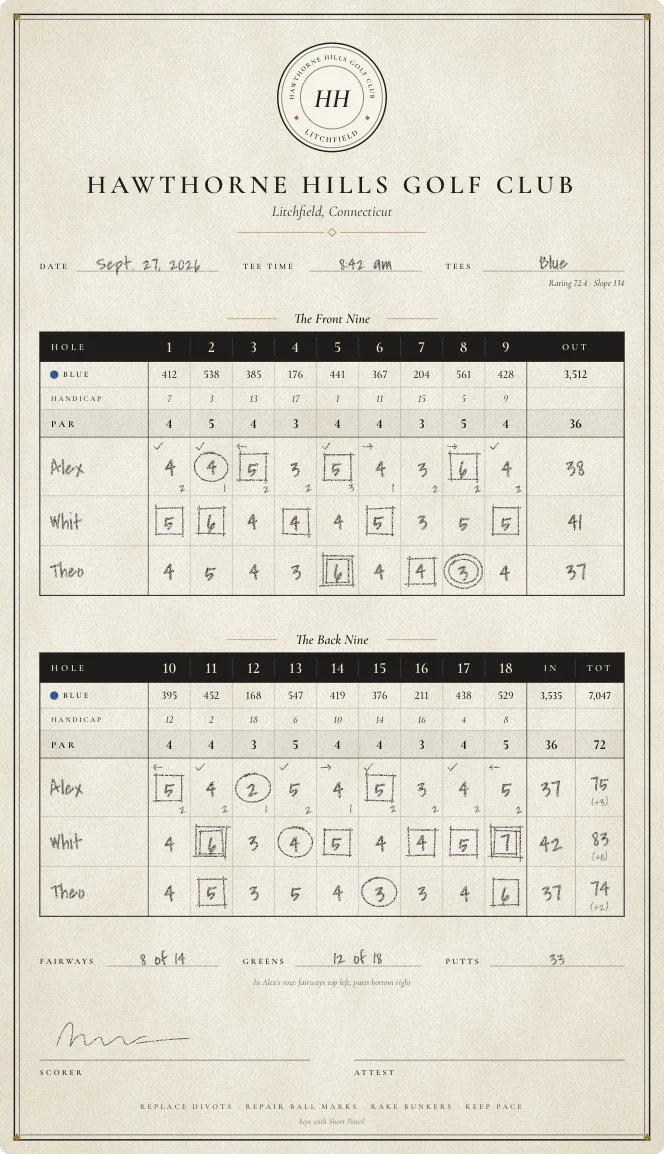
The app keeps totals and to-par for every player, so nobody adds anything on a tee. At the finish, it shows each player’s total, to-par and their birdies, pars and bogeys, and flags any hole where someone has no score, before you sign.
The scorer, the first row, signs with a finger, and a playing partner can attest it on the same phone. That gives the group one signed card; in a competition, the committee’s card is still the one that counts. Short Pencil doesn’t keep skins or Nassau tallies either. It keeps the hole-by-hole scores they’re settled from, and you can email the finished card or send it to the group from the share sheet. Scoring works without signal, and the app keeps putts, fairways and penalties, if you track them, for the scorer’s own row.
On your next foursome, agree the numbers on the walk, write them on the tee and add them up after the 18th. Keep four rows that way and you won’t hold up the group behind.
Questions
Who keeps score in a foursome?
In a casual round, one player keeps the card for everyone, one row each. In a competition, a marker, usually another player in the group, keeps each player’s score, and both certify the card.
When should you write down scores in golf?
On the way to the next tee or at it, not on the green. The R&A’s Pace of Play Manual recommends this, and says the first player to tee off should hit first and mark the card afterward.
How do you play skins with four players?
Each hole is worth a skin, won by a player whose score beats everyone else’s. If the lowest score is tied, the skin carries over and the next hole is worth two.
What is a Nassau in golf?
Three bets in one round: one on the front nine, one on the back nine and one on the full 18. It takes its name from Nassau Country Club on Long Island, where it was devised around 1900.
Who is responsible for mistakes on a golf scorecard?
In a competition, the player. The marker records the scores, but a returned hole score lower than the player made means disqualification, and a higher one stands.
Is there a free golf scoring app for groups?
A paper card is free and holds four players. Short Pencil keeps up to four players on one phone; the first week is free, then a membership is $5.99 a month to start new rounds, and past cards stay open either way.