Guides · Game guide
How a Nassau works.
Three matches in one round, presses and auto-presses, match or stroke play, and handicaps, with one card scored three ways.
November 5, 2026
The Nassau started as a way to make losing look smaller. Around 1900, according to the USGA, J.B. Coles Tappan, a lawyer and legislator who was a member at Nassau Country Club in Glen Cove, on Long Island’s North Shore, split a match into three parts: the front nine, the back nine and the full 18. The worst a member could then lose an inter-club match by was 3–0, which read a good deal better in the local papers than a 7 and 6 drubbing.
The short answer
A Nassau is three bets in one round: the front nine, the back nine and the overall 18, each worth the same. Each is usually played as a match, decided by holes won and lost, and you settle each one on its own, so you can lose the front and still win the back and the 18.
A press is a new bet for the same stake, started by the side that falls 2 down, on the holes left in that nine or the 18. On the card, write both players’ scores on every hole and keep one status line per bet.
Three matches, one round
The front-nine match starts on the 1st tee and ends on the 9th green. The back-nine match starts all square on the 10th, whatever happened going out. The overall runs the whole way, so a hole won on the 12th counts twice: in the back nine and in the 18.
Groups usually name a Nassau by the stake on each bet. A “$5 Nassau” is $5 on the front, $5 on the back and $5 on the overall, so without presses the most that can change hands is three times the stake. It plays as well for points, or for nothing. A nine that finishes all square is a push in most games. Some groups carry it into the next bet instead; National Club Golfer lists both.
On the card: one Nassau, hole by hole
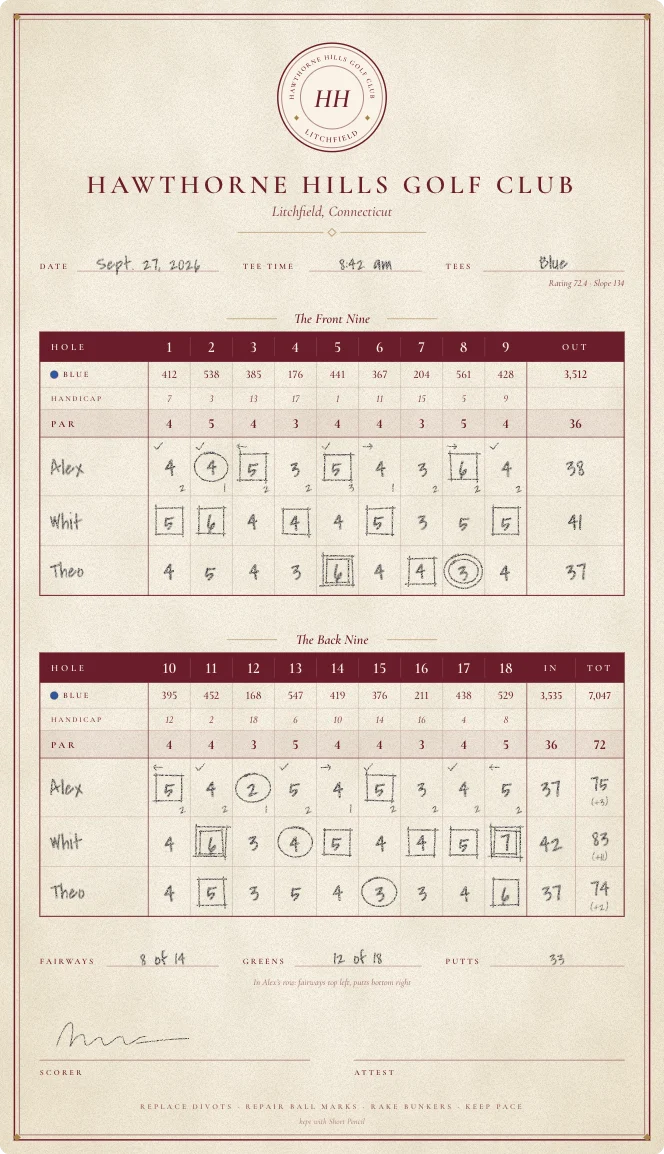
Take Alex against Theo on the card above: gross, match play. The front nine from Alex’s side, with the press Theo calls when he falls 2 down:
| Hole | Par | Alex | Theo | Front nine | Theo’s press |
|---|---|---|---|---|---|
| 1 | 4 | 4 | 4 | All square | |
| 2 | 5 | 4 | 5 | 1 up | |
| 3 | 4 | 5 | 4 | All square | |
| 4 | 3 | 3 | 3 | All square | |
| 5 | 4 | 5 | 6 | 1 up | |
| 6 | 4 | 4 | 4 | 1 up | |
| 7 | 3 | 3 | 4 | 2 up | Called on the 8th tee |
| 8 | 5 | 6 | 3 | 1 up | 1 down |
| 9 | 4 | 4 | 4 | Alex wins, 1 up | Theo wins, 1 up |
Theo’s eagle on the 8th wins the press but not the front nine, which Alex takes 1 up. The back nine is a new match from the 10th tee: Theo wins the 10th and 15th, Alex the 11th, 12th and 18th, so Alex takes it 1 up as well. Over all 18 holes Alex wins six to Theo’s four and takes the overall 2 up, so Alex wins three bets to one.
| Bet | Holes | Result |
|---|---|---|
| Front nine | 1–9 | Alex, 1 up |
| Theo’s press | 8–9 | Theo, 1 up |
| Back nine | 10–18 | Alex, 1 up |
| Overall | 1–18 | Alex, 2 up |
On a paper card, keep one status line per bet under the two rows, written from your side: “+1”, “AS”, “−1”. Start a new line on the tee where a press begins and close every line with its result. The same marks work as in any match; our guide to match play covers them. Short Pencil keeps both players’ gross scores in pencil, hole by hole, for up to four players, with the course’s handicap row on the card. It doesn’t keep match status, Nassau bets or presses, so those lines are yours.
Presses
A press is a new bet laid on top of an old one, for the same stake, by the side that’s losing it. It covers only the holes left in that bet. Press the front nine on the 8th tee and the press is a two-hole match; press the overall on the 13th and it runs to the 18th.
The usual trigger is 2 down. Golf Digest’s guide says a press “can be implemented any time you go 2 down”, and that in practice the side 2 down always does.
Strictly, the leader can decline, though almost nobody does. For the leader it’s double or nothing on the holes that remain. For the trailer it’s a fresh start: Theo, 2 down with two to play on the front, could no longer win it, but he could still win the press, and did.
Two more rules keep presses sane. You can’t press a bet that’s already decided. And a press can itself be pressed when it goes 2 down, which is how a quiet Nassau becomes five bets by the 16th tee. Agree a limit if your group needs one.
Auto-press
An auto-press takes the asking out of it. A new bet opens by itself whenever any bet reaches 2 down: nobody calls it, nobody can decline. Some groups set the trigger at 1 down.
That’s tidy in principle and busy on the card. Run the sample round with an auto-press at 2 down on every bet, each bet pressing once, and one Nassau becomes seven bets: the front, the back, the overall, a press on the front and three on the overall, the last of them starting on the 13th tee. Alex wins four, Theo one, and they halve two.
Our advice: auto-press the nines only, or press by hand. A card should be something the two of you can check in a minute.
Match play or stroke play
Most Nassaus are matches, but the format works at stroke play too: the lower total on each nine wins that bet, and the lower 18-hole total wins the overall. Golf Digest lists it as a variation for strong players; National Club Golfer treats it as a straight alternative.
Decide before the 1st tee, because on the sample card it changes the winner. At stroke play Theo wins the front, 37 to 38, the back is a 37–37 push, and Theo wins the overall, 74 to 75. Same card, same strokes: as matches Alex wins all three; at stroke play Theo wins two and Alex none.
We’d play matches. In a match, a blow-up hole costs you one hole, and keeping one bad stretch from swamping the scoreline is what Tappan was after.
Handicaps in a Nassau
Most groups play Nassaus with strokes. In singles the World Handicap System recommends a 100% allowance for match play, taken off the lower handicap: Course Handicaps of 5 and 9 mean the 9 gets four strokes. In a four-ball Nassau, two against two, the recommended allowance is 90%, again off the lowest player.
The card’s handicap row matters more here than in a single match, because the strokes have two nines to cover. The World Handicap System recommends odd stroke indexes on the front nine and even ones on the back (see scorecard terms), so strokes split evenly. On the sample card, four strokes fall on the 5th and 2nd going out, indexes 1 and 3, and the 11th and 17th coming home, indexes 2 and 4.
Give Theo those four strokes against Alex and the same card flips. Theo’s net 4s on the 2nd and 11th halve holes Alex had won, his net 5 on the 5th halves another, and his net 3 on the 17th wins it. Theo takes the front 1 up and the back 1 up, and closes out the overall 3 and 1, so four dots turn a sweep for Alex into a sweep for Theo.
Mark them before the 1st tee, in the corner of each box where Theo gets a stroke; our guide to handicap strokes shows how. Short Pencil prints the handicap row on the card but doesn’t place the dots or keep net scores, so on a phone, note the four holes before you tee off.
Before your next Nassau, settle three things on the 1st tee: match or stroke, presses by hand or automatic, and how many strokes. On the sample card those choices turn the same 149 strokes into a sweep for Alex, a sweep for Theo, or two bets to none for Theo, and you can’t change any of them once the first ball is in the air.
Questions
How does a Nassau work in golf?
It’s three bets in one round: the front nine, the back nine and the overall 18, each for the same stake and each settled on its own. Most groups play each one as a match, decided by holes won and lost.
What is a press in a Nassau?
A new bet for the same stake, usually started by a side that falls 2 down. It covers only the holes left in the nine or the 18 it was pressed on, and it’s settled separately from the original bet.
What is an auto-press in golf?
A house rule that opens a press automatically whenever a bet reaches a set margin, usually 2 down, so nobody has to call it and the leader can’t decline it.
Is a Nassau played as match play or stroke play?
Usually match play, with each bet decided by holes won. It can also be played at stroke play, with the lower total on each nine and over 18 winning, and the two can produce different winners from the same card.
What does a $5 Nassau mean?
$5 on each of the three bets: the front nine, the back nine and the overall. Without presses, the most anyone can win or lose is $15.
Where does the name Nassau come from?
From Nassau Country Club in Glen Cove, New York, where member J.B. Coles Tappan devised the format around 1900, according to the USGA. The club hosted the 2014 U.S. Women’s Amateur.
How do handicaps work in a Nassau?
In singles, the higher handicap usually gets the full difference in Course Handicaps, one stroke on each of the hardest holes by the card’s handicap row. Because odd indexes are usually on the front nine, the strokes split evenly between the nines.