Guides · Scoring guide
How to break 100.
The 99 card, where the extra strokes really go, how to read your last card for penalties and three-putts, and why net double bogey won’t save your round.
November 4, 2026
You can break 100 without making a single par. Bogey the nine easiest holes on a par-72 course, double-bogey the nine hardest, and you sign for 99.
That makes 100 a scorecard problem before it’s a swing problem. The strokes that keep you in triple figures come from the holes that go past double: a ball out of bounds, a chip that stays short of the green, three putts from the edge. Mark all three on your card and you can see which one costs you most.
The short answer
On a par-72 course, 99 is 27 over par. Aim for double bogey on the nine hardest holes (handicap 1 to 9 on the card) and bogey on the other nine, and that’s 99 without a single par. Any hole worse than double breaks the plan, and those come from three places: penalty strokes, three-putts and missed greens that take more than one chip.
Track putts and penalties for a few rounds, count the double boxes on your card, and look at what’s in their corners. Practice whatever shows up most often.
The 99 card
Start with the handicap row, the stroke index that ranks every hole from 1, the hardest, to 18. Give yourself a double on the nine lowest numbers and a bogey on the rest:
| Holes | Your target | Over par |
|---|---|---|
| Handicap 1 to 9 | Double bogey | 18 |
| Handicap 10 to 18 | Bogey | 9 |
| Round | 72 + 27 | 99 |
The 99 card is also net par for a Course Handicap of 27. That golfer gets two strokes on the holes ranked 1 to 9 and one on the rest, so the card is the handicap system’s own picture of a 27 playing to handicap. The USGA says most golfers manage that only 20 to 25% of the time. A 27 needs a good day to break 100 once; breaking it most weeks takes a lower handicap.
The targets are gentler than they look. In Arccos data analyzed by Lou Stagner and published by Golf.com in November 2023, a 20 handicap averaged 1.58 over par on the hole ranked 1. The 99 card allows two.
Not on a par 72? Take par away from 99 and spread what’s left the same way. A par 70 leaves 29: doubles on the eleven hardest holes, bogeys on the other seven.
Where the strokes go
Birdies have little to do with breaking 100. Doubles and worse decide it, and the pattern shows up well below 100, in Arccos’s per-round figures for a 5 handicap and a 15 handicap, published on its blog in October 2023:
| Per round | 5 handicap | 15 handicap |
|---|---|---|
| Birdies | 1.2 | 0.5 |
| Pars | 8.9 | 5.3 |
| Bogeys | 6.4 | 8.4 |
| Double bogeys or worse | 1.6 | 4.2 |
The birdie gap is less than one a round; the double gap is 2.6. Higher up the range the doubles keep coming. Arccos tracked its members’ rounds at Aronimink, the 2026 PGA Championship course, and its 15-to-20 and 20-to-25 handicap groups averaged 93.4 and 99.6, with the higher-handicap golfers making 7.4 doubles a round and hitting 2.2 greens in regulation (Arccos, May 2026).
At 2.2 greens a round, your job is to keep the hole to a bogey or a double once you’ve missed the green, and three things turn a missed green into a triple:
- Penalty strokes. Arccos data reported by Golf Digest in July 2025 found that when a scratch golfer’s approach finds a penalty area, a double bogey follows nearly 60% of the time; for a 10 handicap, closer to 80%.
- Three-putts. Arccos found in 2017 that golfers with handicaps over 15 averaged 3.2 three-putts a round, double the 1.6 of a 1-to-5 handicap.
- Extra chips. A chip that stays off the green, or runs across it, adds a stroke before the putting has even started.
Reading your last card
Take your last round, find every double box and every hole worse than double, and look at what else is in the box.
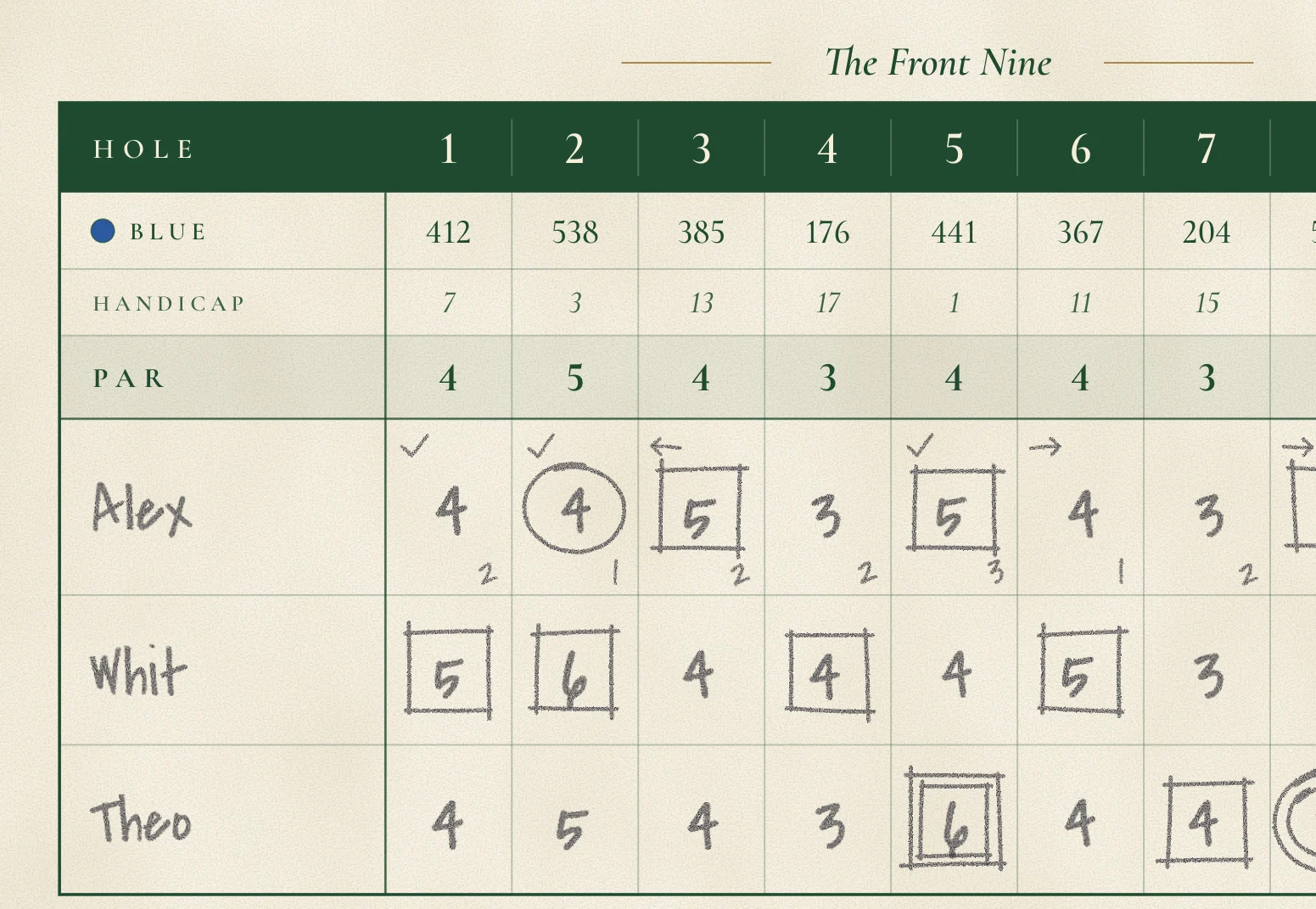
| In the box | What made the double | Next round |
|---|---|---|
| P or P2 in the top right | A penalty | Change the club or the target on that shot and leave the swing alone. |
| A 3 in the putts corner | The green | Give the first putt one job: finish close. |
| An arrow, no P | The recovery from a missed fairway | Get back to the fairway first, then go for the green. |
| Two putts, no P | Too many shots to reach the green, often an extra chip | Aim at the middle of the green. |
One more sum is worth doing on every hole. Subtract the putts from the score and you have the strokes it took to reach the green. If that’s par minus one (two on a par 3, three on a par 4, four on a par 5), you were on in one more than regulation, and two putts from there make a bogey. Make a double from there and you lost it on the green.
Short Pencil does the counting if you let it. Choose “Track putts, fairways & penalties” when you set up a round and you can fill in the corners of your own row as you go. Before anyone signs, the finish screen tallies each player’s round: “1 birdie · 6 pars · 8 bogeys · 3 doubles+”.
Penalties: pay one, never two
A ball out of bounds or lost costs stroke and distance under Rule 18.2, so a tee shot out of bounds makes the next one off the tee your third. If the ball might be lost or out of bounds, play a provisional (Rule 18.3) before you walk forward to look. Our guide to keeping score covers the two-stroke alternative some courses offer, Model Local Rule E-5.
A penalty area costs one stroke under Rule 17.1d. You can play again from where you last hit; drop back on a line that keeps the point where the ball crossed the edge between you and the hole; or, if the area is marked red, drop within two club-lengths of where it crossed. Pick the one that leaves you on grass with a clear shot, even if it’s farther back.
The second penalty is the expensive one. It usually comes straight after the first: the shot from the edge of the water, or the driver again on the hole where the first one went out.
Better still, avoid the first. On a hole with out of bounds down one side, the club you can keep in play beats the club that goes farthest, and you choose it on the tee without changing your swing.
Three-putts: the first putt’s job
On a green you reached in one more than regulation, two putts make bogey and three make double, so the job of a long first putt is to make the second one easy. Judge it by where it finishes. Speed decides that more than line: a first putt that dies a few feet past the hole has done its job, and one that stops well short has left you the hardest putt of the day.
Then count them. Every 3 in the putts corner is a stroke the hole didn’t need to cost, and with four of them you’ve given back four strokes before anything else has gone wrong. Our guide to tracking stats on your scorecard shows how to keep the count.
Net double bogey, and why you shouldn’t pick up
Post a score for your handicap and the system caps every hole at net double bogey: par, plus two, plus your strokes there. For a Course Handicap of 27, that’s a quadruple bogey on the holes ranked 1 to 9 and a triple on the rest; before you have a Handicap Index, it’s par plus five. The calculation is in our guide to handicap strokes.
The 99 card sits two strokes inside the cap on every hole. The cap exists so one disaster can’t wreck your handicap, and it does nothing for your 99.
Nor does picking up. Under Rule 3.3 of the Rules of Handicapping, if you pick up for a valid reason, and reaching net double bogey is one, you record your most likely score and the round still counts for your handicap. It doesn’t count toward breaking 100, because a 98 with a picked-up hole on it has a guess in the total. On the day you’re chasing it, hole everything out.
Go into your next round knowing which nine holes are your doubles, and play them like it, with a club off the tee that keeps the ball in play and the middle of the green as your target.
Questions
How do you break 100 in golf?
Plan for bogey on the nine easiest holes and double bogey on the nine hardest, which adds up to 99 on a par-72 course, then avoid what turns a hole into a triple: penalty strokes, three-putts and extra chips.
Can you break 100 making double bogeys?
Yes. Nine double bogeys and nine bogeys on a par-72 course add up to 99, with no pars at all.
What handicap do you need to break 100?
On a par-72 course, 99 is net par for a Course Handicap of 27. Most golfers play to their handicap only 20 to 25% of the time, according to the USGA, so breaking 100 regularly takes a lower handicap than that.
What percentage of golfers break 100?
We couldn’t find a figure published by the National Golf Foundation or the USGA. The NGF says golfers who keep score average 94 for 18 holes, and that the true average, including those who don’t, is probably closer to 100.
Should you pick up on a bad hole?
For your handicap, you can record your most likely score, capped at net double bogey. But a round with a picked-up hole has no true total, so on a day you’re trying to break 100, hole out every putt.
How much do three-putts matter for breaking 100?
A lot. Arccos found in 2017 that golfers with handicaps over 15 averaged 3.2 three-putts a round, and every three-putt costs a stroke that two putts would have saved.