Guides · Scoring guide
How to keep score in golf.
Filling out the card hole by hole, what every row means, where your handicap strokes go, and signing it at the end.
October 20, 2026
A golf score is the simplest number in sport: count every stroke, add any penalties, write it down. What makes a scorecard look complicated is everything printed around that number, the yardages for four sets of tees, a row of handicap figures, the ratings in the corner. Most of it you can ignore on your first round. A little of it you can’t.
Here’s how to fill out a card hole by hole, what each row is for, where your handicap strokes go, and what to check before you sign it.
The short answer
Count every stroke you make on a hole, including any penalty strokes, until the ball is in the hole. Write that number in your row under the hole number. Add the first nine holes into the Out box and the second nine into In, then add those for your Total.
In a competition, another player (your marker) keeps your score, and at the end you both check every hole and sign the card.
Reading the card, row by row
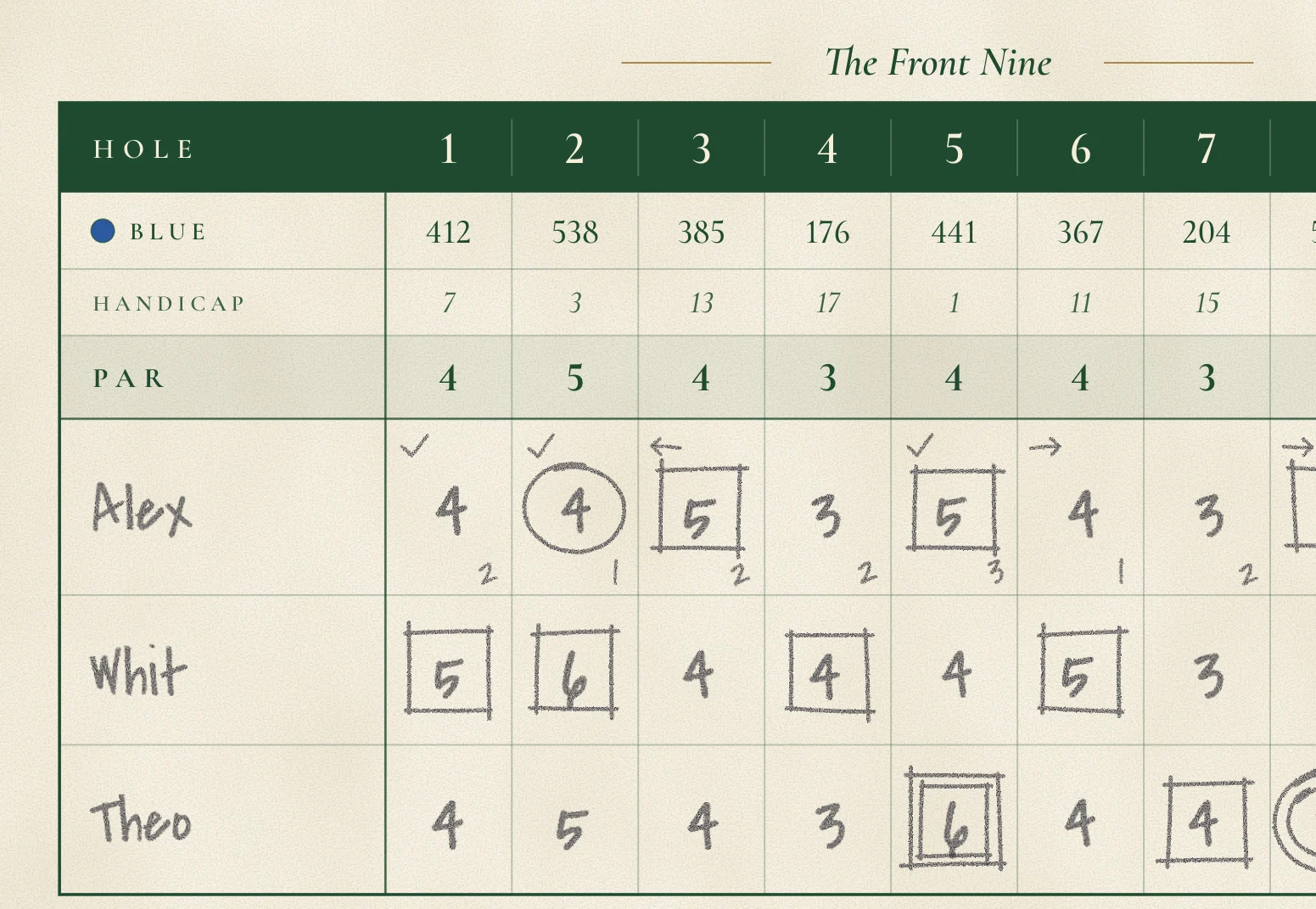
| Row | What it tells you |
|---|---|
| Hole | Holes 1 to 9 on the front, 10 to 18 on the back. |
| Tee rows (Blue, White…) | The length of each hole in yards from that set of tees. Find the color you’re playing and ignore the rest. |
| Handicap (stroke index) | How hard each hole plays compared with the others, from 1 (hardest) to 18. It decides where handicap strokes go. |
| Par | The score a good player is expected to make: 3, 4 or 5 on most holes. |
| Your row | Your score on each hole, plus Out, In and Total. |
| Rating and slope | Numbers for each set of tees used to work out handicaps. You don’t need them to keep score. |
On the card above, the 5th is 441 yards from the blue tees, a par 4, and handicap 1: the hardest hole on the course. The 4th is a 176-yard par 3 and handicap 17, one of the easiest.
What counts as a stroke
Every swing you make at the ball counts, including the one that misses it entirely. Practice swings don’t. Nor does accidentally knocking the ball off the tee before you’ve started your swing.
Penalty strokes count too, and they’re where most beginners’ scores go wrong. The common ones:
- Out of bounds or a lost ball: one penalty stroke, and you play again from where you hit the last shot. Hit your tee shot out of bounds and the next ball off the tee is your third stroke. The Rules call this stroke and distance (Rule 18.2).
- Into a penalty area (water, usually marked with red or yellow stakes): one penalty stroke, then drop under the options the stakes allow.
- An unplayable ball: one penalty stroke, if you decide you can’t play it where it lies.
Since 2019 there’s been an alternative that courses can adopt for casual play, Model Local Rule E-5: you drop near where the ball went out of bounds or was lost, for two penalty strokes, instead of walking back to the tee. Ask in the pro shop whether it’s in effect.
Our advice for a first season: count everything, and write the real number.
A 9 on a par 4 is a perfectly normal score for a new golfer. An honest 9 is also the only way you’ll ever see yourself improve.
Out, In and Total
The front nine is “Out” because those holes traditionally lead away from the clubhouse, and the back nine is “In”. Add holes 1 to 9 into Out, 10 to 18 into In, and the two together into Total. On a 9-hole card there’s just one total.
Do the adding at the end, not as you go. Running totals invite arithmetic mistakes, and in a competition the committee checks the addition anyway. What has to be right is each hole.
Where your handicap strokes go
A handicap gives you strokes to take off your score so you can compete with better players. How many you get in a round (your playing handicap) depends on your Handicap Index, the tees and the format. They aren’t spread evenly: they go on the hardest holes first, in the order of the handicap row (the stroke index).
- Getting 10 strokes in the round, you take one on each of the holes with handicap 1 to 10.
- Getting 18, you take one on every hole.
- Getting 22, you take one on every hole and a second on the holes with handicap 1 to 4.
Your gross score is what you actually took. Your net score is gross minus the strokes you get on that hole. On the card above, a golfer with a stroke on the 5th who makes a 5 there has a net 4: a net par on the hardest hole on the course.
Write the gross score in the box. Many golfers mark the holes where they get a stroke with a small dot in the corner, so the net score is easy to read off later. If you’re posting a score for your handicap, each hole has a cap called net double bogey: par, plus two, plus any strokes you get there. Until you have a Handicap Index, the cap is par plus five.
Keeping score for someone else, and signing the card
In a friendly round, one person usually keeps everyone’s score. In a competition it works differently: you’re paired with a marker, usually a playing partner, who records your score on your card while you record theirs.
Agree each score before you walk to the next tee. At the end, go through the card hole by hole together. The marker certifies it, usually by signing, then you certify it and hand it in promptly; after that it can’t be changed. Leaving it uncertified is, by default, a disqualification.
Check the holes, not just the total: under Rule 3.3b you’re responsible for each hole score being right. Hand in a score lower than you actually took on any hole and you’re disqualified; hand in one that’s higher and the higher score stands. The one exception is a penalty you didn’t know about, which the committee simply adds. The adding up and the handicap arithmetic are the committee’s job, not yours.
That rule once decided a major. At the 1968 Masters, Roberto De Vicenzo’s marker wrote a 4 on the 17th, where he had made a 3. De Vicenzo signed the card, the 4 stood, and he finished one stroke behind Bob Goalby instead of tied with him.
Other ways to keep score
Everything above is stroke play, where every stroke on every hole counts. Three other formats come up often:
Stableford
Points per hole, based on your net score against par. The highest total wins, and a disaster hole only costs you that hole.
| Net score on the hole | Points |
|---|---|
| Double bogey or worse | 0 |
| Bogey | 1 |
| Par | 2 |
| Birdie | 3 |
| Eagle | 4 |
| Albatross | 5 |
Match play
You play against one opponent hole by hole. The lower score wins the hole, an equal score halves it, and the match is told in holes: “2 up”, “all square”. It ends when one player is ahead by more holes than are left, written like “3 and 2”: three up with two to play.
Scramble and best ball
In a scramble, everyone on the team hits, the team picks the best shot, and everyone plays the next one from there until the ball is holed, so the team writes down one score per hole. Scramble scores can’t be posted for a handicap. In four-ball, often called best ball, you and a partner each play your own ball and the side takes the lower score on each hole.
Golf keeps score the way it does so that every round, on any course, can be read by anyone. Get the number in each box right and everything else on the card takes care of itself.
Questions
How do you keep score in golf as a beginner?
Count every stroke on each hole until the ball is in the cup, add any penalty strokes, and write the number in your row under that hole. At the end, add the front nine, the back nine and the total.
Do penalty strokes count in your score?
Yes. A ball out of bounds, lost, in a penalty area or declared unplayable each adds one penalty stroke to your score for the hole, on top of the strokes you made.
What does the handicap row on a scorecard mean?
It ranks the holes from 1, the hardest, to 18, the easiest. Handicap strokes go on the hardest holes first: a course handicap of 10 gets one stroke on the holes ranked 1 to 10.
What is the difference between gross and net score?
Your gross score is the strokes you actually took. Your net score is your gross score minus your handicap strokes.
Who signs a golf scorecard?
In a competition, both your marker, who kept your score, and you. The marker certifies the hole scores, then you do, usually by signing, and you hand the card in.
Is there a maximum score on a hole?
Not in stroke play: you count every stroke until the ball is holed. For handicap purposes, each hole is capped at net double bogey: par plus two plus any handicap strokes you get on that hole, or par plus five before you have a Handicap Index.