Guides · Scorecard guide
Signing a golf scorecard.
Who marks your card, what you’re certifying when you sign, what to check first, and what happens when a hole score is wrong.
October 25, 2026
Jackie Pung’s total was right. At the 1957 U.S. Women’s Open at Winged Foot she finished a stroke ahead of Betsy Rawls and was disqualified anyway, because her card showed a 5 on the 4th hole, where she’d made 6. Her playing partner Betty Jameson had written it down; Pung had made the same mistake on Jameson’s card, and both women were out.
Most of what you need to know about signing a scorecard is in that afternoon. Each hole score stands on its own, whatever the total says, and the card becomes yours the moment you certify it.
The short answer
In a stroke-play competition, your marker (usually another player, never your partner) enters your score after each hole and certifies the card at the end. You check every hole, certify it yourself, usually by signing, and hand it in promptly. That’s Rule 3.3b.
Return a hole score higher than you made and it stands. Return one lower and you’re disqualified, unless the difference is a penalty you didn’t know about. The total and the handicap are the committee’s job. In a casual round nobody has to sign anything, but a score you post for your handicap has to come from a round played with at least one other person.
Marker, player and committee
Three parties touch a competition scorecard, and the Rules give each a separate job.
| Who | Their job | Rule |
|---|---|---|
| Marker | After each hole, confirms your strokes with you, penalties included, and enters the gross score. Certifies the hole scores when the round ends. | 3.3b(1) |
| Player | Keeps track during the round, checks every hole score, makes sure the marker certifies, changes a score only with the marker’s agreement or the committee’s approval, then certifies and promptly returns the card. | 3.3b(2) |
| Committee | Adds up the scores and applies the handicap strokes. | 3.3b(4) |
The marker can be another player, usually someone in your group, but never your partner, and you keep the same one for the whole round unless the committee approves a change. A marker may refuse to certify a score they believe is wrong, leaving the committee to decide. A marker who is a player and knowingly certifies a wrong score should be disqualified under Rule 1.2a, the serious-misconduct rule.
What signing actually means
Rule 3.3b’s word is certify, and a signature is one way to do it. The definition of a scorecard allows either a physical signature or an electronic method the committee approves, so in an event scored through an app, confirming on the screen can be your certification.
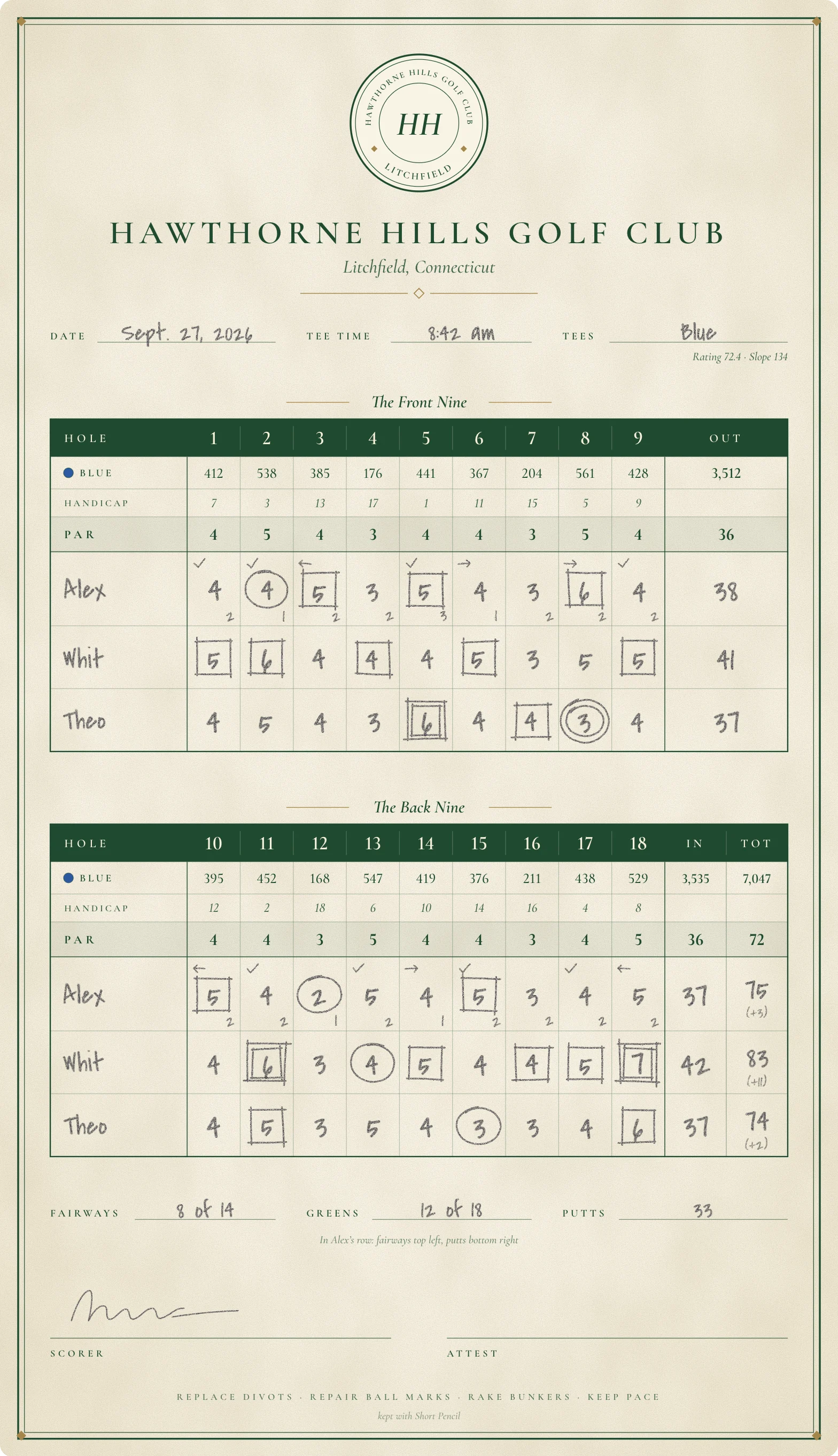
On paper, the two lines go by different names. Some cards print Marker and Player, others Scorer and Attest. Whatever the labels, the Rules need two certifications: your marker’s and yours. If you can’t tell which line is whose, ask the committee before you sign.
What to check before you sign
Sit down with your marker and go through the card hole by hole, out loud, before either of you signs.
- Every hole against your own count, penalty strokes included. A 5 where you made 6 is the mistake that ended Pung’s Open.
- Any penalty you weren’t sure about. Raise it with the committee before you hand the card in. The exception for unknown penalties doesn’t cover one you were told about, or suspected, and kept quiet on.
- No blank holes. A missing hole score counts as a low one: disqualification.
- Your name on the card, and any correction agreed with your marker rather than made by you alone.
Don’t spend the time on the total. Since 2023, Rule 3.3b(4) has made the adding up and the handicap the committee’s job, and a mistake in either costs you nothing.
When the card is wrong
| What the card shows | What happens | Famous case |
|---|---|---|
| A hole score higher than you made | The higher score stands | Roberto De Vicenzo, 1968 Masters |
| A hole score lower than you made, or none | Disqualification | Jackie Pung, 1957 U.S. Women’s Open; Jordan Spieth, 2024 Genesis Invitational |
| Lower only because of a penalty you didn’t know about | No disqualification; the committee adds the penalty, if it finds the mistake before the competition closes | Craig Stadler, 1987 (disqualified under the old rules) |
| A wrong total, or a wrong handicap | No penalty; the committee fixes it | None |
The most famous signature in golf went the other way. On April 14, 1968, his 45th birthday, Roberto De Vicenzo birdied the 17th in the final round of the Masters. His playing partner Tommy Aaron, keeping his card, wrote down a 4. De Vicenzo signed it, the 66 stood instead of the 65 he’d shot, and Bob Goalby won by a stroke at 277 instead of meeting him in a playoff. “What a stupid I am,” De Vicenzo said afterward.
It still happens to the best players in the world. At the 2024 Genesis Invitational, Jordan Spieth signed for a 3 on Riviera’s par-3 4th, where he’d made 4, and was disqualified after the second round.
The unknown-penalty exception would have saved Craig Stadler. At the 1987 Andy Williams Open at Torrey Pines he knelt on a towel to keep his pants clean while playing from under a tree, which counted as building a stance: a two-stroke penalty he didn’t know he’d taken. He signed without it and was disqualified. Today the committee would add the two strokes and that would be the end of it, as long as someone found the mistake before the competition closed.
Forgetting to sign, and when the card counts as returned
A card handed in without both certifications is, by default, a disqualification under Rule 3.3b(2). Two things soften it.
If the breach was the marker’s fault and beyond your control (the marker walked off with your card, say, or left without certifying it), there’s no penalty at all.
A committee can also adopt Model Local Rule L-1, which turns a missing certification from you, your marker or both into the general penalty: two strokes, added to your last hole. It only applies where the committee has adopted it, so check the local rules or the terms of the competition.
The committee decides when the card counts as returned, and after that nothing on it can change. After Spieth’s disqualification, the PGA Tour introduced a 15-minute window in June 2024 for players to come back and fix a mistake, even after leaving the scoring area, and since January 2025 the official guidance for committees has confirmed that any competition may use a time-based policy like it. Unless yours has announced one, treat the moment you hand the card over as final.
Can you mark your own scorecard?
In a casual round, yes. Certifying a card is a competition procedure: Rule 3.3b is about returning it to a committee, and in match play a scorecard isn’t required at all.
Posting that score for your handicap is a different question. Under Rule 2.1 of the Rules of Handicapping, a score is acceptable only if you played in the company of at least one other person, who may also act as your marker. You can keep your own card, but you can’t post a score from a round you played alone.
Your national association decides how a posted score gets certified (Rule 4.4): by a marker’s signature or electronic certification, by peer review, or both. In the US, the USGA relies on peer review. You post the score yourself, it has to be available to other golfers at your club as soon as possible after the round, and anyone with a reasonable basis can question it. Other associations ask for more, such as a playing partner confirming the score before it counts.
We think the competition habit is worth keeping anyway. In Short Pencil you sign the Scorer line with your finger, a playing partner can attest underneath, and the signed card goes into your round journal. In a casual round nobody else will check the card, so a playing partner going over the 4th hole with you is worth the minute it takes.
A signature takes two seconds, and it has cost one golfer a Masters playoff and another a U.S. Women’s Open. Go through the holes with your marker first, out loud, and sign once every number matches your own count.
Questions
Can you mark your own scorecard in golf?
In a casual round, yes. In a stroke-play competition, no: someone else, usually another player in your group, acts as your marker and records your scores. To post a score for your handicap, you must have played with at least one other person.
Who signs a golf scorecard?
In a stroke-play competition, two people: your marker, who certifies the hole scores they recorded, and you, the player. You then return the card to the committee.
What does attest mean on a golf scorecard?
To attest is to confirm that the scores on the card are right. On cards with Scorer and Attest lines, it is the second of the two certifications the Rules require from the marker and the player.
What happens if you sign an incorrect scorecard?
If a hole score is higher than you made, the higher score stands. If it is lower, you are disqualified, unless the difference is a penalty you didn’t know about, which the committee adds instead.
What happens if you forget to sign your scorecard?
By default, disqualification under Rule 3.3b(2). There is no penalty if your marker caused the problem in a way beyond your control, and under Model Local Rule L-1, if the committee has adopted it, the penalty is two strokes instead.
Do you have to add up your own scorecard?
No. Under Rule 3.3b(4), the committee adds up the scores and applies handicap strokes, and there is no penalty for a mistake in either.
Can your partner be your marker in golf?
No. In stroke play your marker can be another player, but not your partner.